


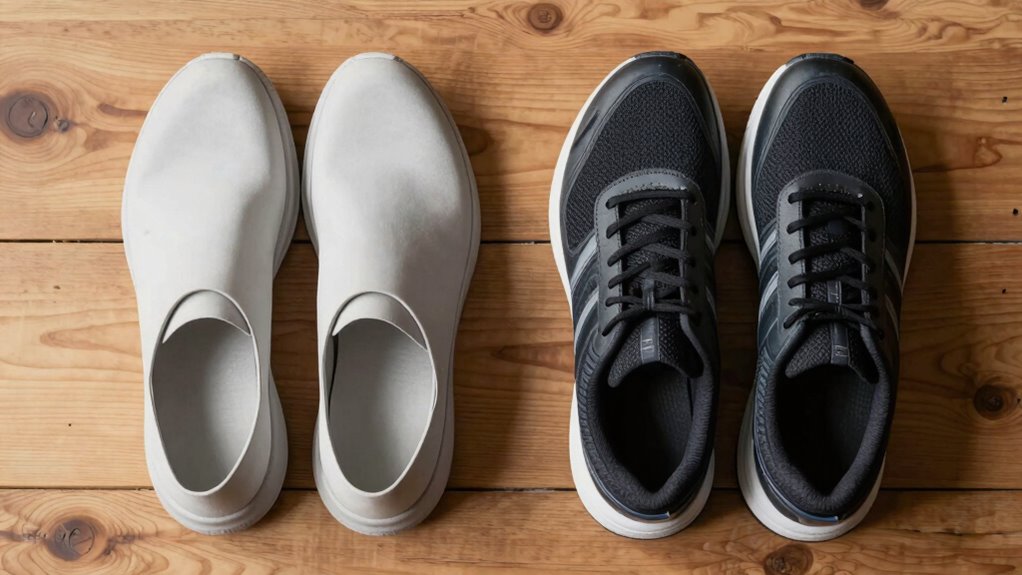
To choose between neutral and stability shoes, examine your foot type and wear patterns. Check your shoe’s outsoles: neutral patterns indicate balanced pronation, while medial wear suggests overpronation. Conduct a wet test to assess your arches. High arches require neutral shoes, low arches benefit from stability shoes. Test your balance with single-leg stances and track any discomfort. Gradually shift when switching shoes. Discover more about matching shoe types to your specific needs in further insights.
Understanding Your Foot Type


Do you know your foot type and how it influences your choice of footwear? Understanding your foot structure is essential for selecting the right shoes.
Your arch characteristics, whether high, normal, or low, dictate the biomechanical function of your foot. High arches, or cavus feet, typically have rigid structures and lateral pressure distribution, whereas low arches, or planus feet, are more flexible with a tendency to overpronate.
High arches are rigid with lateral pressure, while low arches are flexible and tend to overpronate.
Toe alignment also plays a role; for example, Greek feet, with a longer second toe, can affect shoe fit. Additionally, foot flexibility and pressure distribution impact how your foot interacts with the ground.
Identifying these factors can guide you in choosing footwear that supports your biomechanical needs and enhances comfort.
Evaluating Wear Patterns and Arch Tests
Understanding your foot type is a key step in choosing the right footwear, but equally important is recognizing the wear patterns on your shoes and conducting simple arch tests.
Examine your shoes by placing them on a flat surface and photographing the outsoles to assess wear patterns. Neutral wear, seen in the central forefoot-to-midfoot, suggests balanced pronation. Medial wear indicates overpronation, often linked to flat arches, while lateral wear suggests underpronation.
Use the wet test to identify your arch type: a broad imprint suggests low arches, while a slim midfoot contact indicates high arches.
These tests help guide you toward the right shoe type, whether stability for overpronation or neutral shoes for balanced or underpronation wear patterns.
Assessing Balance and Dynamic Control
When determining the right footwear, evaluating balance and dynamic control can be as vital as understanding your foot type. Conducting a balance assessment helps identify potential stability needs.
Consider these tests:
- Single-leg stance time: Shorter durations may indicate a need for supportive shoes.
- Tandem walk: Difficulty maintaining a straight line suggests reduced dynamic control, favoring stability features.
- Timed Up and Go (TUG): Longer completion times reflect impaired balance, guiding you toward stability footwear.
- Dual-task balance tests: Decreased performance indicates real-world control deficits, suggesting a preference for stability-enhancing shoes.
Dynamic control during gait is important too. Look for signs like step width variability and heel-strike to toe-off timing asymmetry. A well-rounded training strategy that incorporates cross-training and stretching can also improve balance and reduce the risk of injury. These can inform your choice, potentially benefiting from stability shoes with structured support.
Comfort and Symptom Monitoring

Evaluating balance and dynamic control provides insight into your footwear needs. Comfort preferences play a significant role in selecting the right shoe. Neutral shoes, with their lighter and more flexible design, often provide an immediate plush sensation due to softer midsoles and less structural intrusion. This makes them ideal for long-distance running. Conversely, stability shoes, with their firmer medial support, may feel less cushioned initially but offer benefits for overpronators during shorter runs. Symptom tracking is essential. Keep a log of any pain or soreness, noting its location, intensity, and timing. New discomfort, like medial knee pain or plantar fascia issues, might indicate that your current shoe choice isn’t addressing your needs. Monitoring these symptoms guarantees you can make informed footwear decisions. For those experiencing discomfort, runner’s knee is a common condition that can be managed through strengthening exercises and flexibility routines.
Progressive Testing and Adaptation
Although the excitement of new running shoes is undeniable, moving to a new shoe type requires careful and progressive testing to confirm both comfort and performance.
Start with short runs in your new shoes to gauge initial reactions. Gradually increase your distance by 10% weekly if no issues arise. It’s wise to alternate between your old and new shoes during this shift.
Perform regular flexion testing, focusing first on the distal third for minimal resistance, then progressing to the middle third. Before you finish, verify your shoes pass a torque assessment by checking heel counter rigidity.
- Monitor wear patterns after 50-100 miles.
- Test for consistent flexion and torque weekly.
- Fully change in 2-4 weeks.
- Alternate shoes to prevent strain.
Incorporating strength training into your routine can further enhance your running efficiency and reduce injury risk, supporting a smoother transition between shoe types.
Wrapping It Up
Choosing between neutral and stability shoes is like finding the right gear for a journey; it guarantees comfort and efficiency in every step you take. By understanding your foot type, evaluating wear patterns, and monitoring comfort, you can make an informed decision. Remember, your feet are unique, and progressive testing and adaptation will guide you to the best fit. Keep monitoring your comfort and symptoms, as they’re key indicators of whether you’ve chosen the right path for your footwear needs.