
To develop an effective training plan for running with a disability, you’ll need specialized adaptive equipment matched to your specific needs and a qualified coach who understands disability-specific modifications. Focus on building a strong foundation through personalized workouts, proper safety protocols, and appropriate guide running techniques if needed. Working with supportive training communities and experienced mentors can enhance your progress while maintaining safety. The journey to becoming a successful adapted runner begins with understanding these key components.
Understanding Different Adaptive Equipment Options
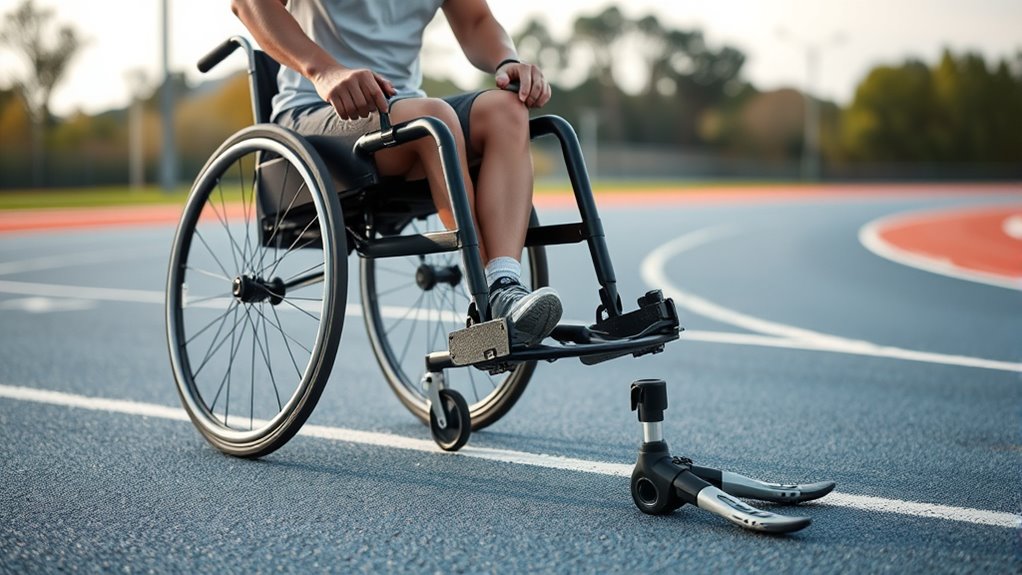
When adapting running programs for individuals with disabilities, selecting the right equipment forms the foundation of a successful training experience.
Recent adaptive equipment innovations include prosthetic running blades with dynamic energy return, specialized race running frames, and advanced mobility aids that enhance performance and safety.
Your equipment selection criteria should focus on matching the device to your specific needs.
Equipment must be precisely tailored to individual requirements for optimal performance and safety in adaptive running programs.
If you’re dealing with visual impairments, you’ll want to evaluate guide runners and audio navigation tools.
For mobility challenges, assess options like custom braces or wheelchair configurations.
The key is choosing equipment that maximizes your independence while ensuring proper biomechanical support.
Building a Safe and Effective Training Foundation
Before you begin any adaptive running program, you’ll need an extensive medical assessment to identify your specific needs and limitations.
You’ll want to consult with your healthcare provider, physical therapist, and prosthetist to develop a personalized training approach that accounts for your unique mobility considerations.
Proper safety equipment, including well-fitted prosthetics, appropriate footwear, and any necessary mobility aids, must be thoroughly evaluated and tested to ascertain they meet your training requirements.
Medical Assessment First Steps
Since every runner’s disability presents unique challenges and considerations, establishing a thorough medical assessment serves as the cornerstone of a safe and effective training program.
You’ll need to start with an extensive disability assessment that evaluates both the type and origin of your condition. Work with your healthcare provider to review your complete medical history, including any assistive devices you use and your current level of independence in daily activities.
This information helps create a baseline understanding of your capabilities and potential limitations, ensuring your training plan is both safe and appropriately challenging.
Safety Equipment Requirements
The foundation of any successful adaptive running program rests on selecting and utilizing appropriate safety equipment.
You’ll need to prioritize essential safety gear based on your specific needs. For visually impaired runners, tethers and audio navigation apps provide vital guidance, while reflective clothing guarantees visibility on shared paths.
If you’re using mobility aids, verify your prosthetics, braces, or wheelchairs meet proper specifications for running.
Don’t forget to incorporate tactile or visual alert systems based on your sensory requirements. All equipment should be tested and adjusted before beginning your training program.
Personalized Coaching Strategies for Different Abilities
Successful coaching strategies for runners with disabilities demand a highly individualized approach that adapts to each athlete’s unique needs and capabilities.
You’ll need to assess individual strengths and adjust your coaching styles to accommodate different learning preferences and physical requirements.
When developing training plans, incorporate ability banding to group athletes appropriately and modify rules as needed.
You can integrate assistive equipment like custom prosthetics or tactile navigation aids while maintaining clear communication through various methods.
Consider using visual instructions for hearing-impaired runners or tactile signals for visually impaired athletes.
Always plan for reduced intensity phases when necessary to prevent fatigue.
Guide Running Techniques and Partnership Development
Mastering guide running techniques requires careful attention to both physical coordination and effective partnership dynamics.
When developing guide runner dynamics, focus on these essential elements to build strong partnership synergy:
- Match stride patterns and maintain a consistent 30cm tether length to guarantee fluid movement between partners.
- Practice clear verbal communication using pre-established signals for immediate response to course changes.
- Develop haptic awareness through tether tension to interpret nonverbal cues about pace and direction.
- Build adaptive experience by regularly training together in various conditions and terrains.
Remember to prioritize safety while fostering natural running mechanics between guide and runner.
Adapting Workouts for Sensory and Mobility Needs

When adapting workouts for runners with disabilities, customized training plans must address both sensory and mobility considerations to guarantee safe, effective progress. You’ll need to focus on developing sensory awareness through tactile path training and auditory cues while managing mobility challenges with specialized equipment.
| Adaptation Type | Primary Focus | Key Equipment |
|---|---|---|
| Prosthetic | Speed/Agility | Running Blades |
| Balance | Core Stability | Support Braces |
| Sensory | Navigation | Audio Apps |
| Terrain | Safety | Smooth Paths |
| Intensity | Progression | Monitoring Tools |
Start with smooth terrain and gradually increase difficulty as you build confidence. Incorporate balance exercises to enhance stability, especially if you’re using prosthetics or dealing with limb differences.
Creating Supportive Training Communities
Building supportive training communities requires a multifaceted approach that integrates diverse participants while fostering an environment of mutual growth and understanding.
Through community engagement and peer mentorship, you’ll create lasting connections that enhance everyone’s running journey.
Key elements of successful training communities include:
- Mixed-ability group sessions that promote collaborative learning and shared achievements
- Volunteer guide programs pairing experienced runners with visually impaired athletes
- Inclusive events that welcome participants regardless of experience or ability level
- Mentorship opportunities where accomplished adaptive athletes inspire and support newcomers
These components create an environment where every runner can thrive and develop their full potential. Additionally, incorporating mental resilience through consistent running routines can significantly enhance participants’ emotional well-being.
Conclusion
Isn’t it amazing how adaptive running has evolved to become more inclusive and accessible than ever before? You’ve now got the tools to create specialized training plans that cater to diverse abilities and needs. By implementing proper equipment, safe training foundations, and personalized coaching strategies, you’re ready to build an inclusive running program. Remember, success comes from combining technical expertise with a supportive community that celebrates every runner’s unique journey.
I just finished rehab after a below-knee amputation and want to start run-walk sessions again, but my regular doctor only offered a standard physical. Before I sign up with a coach, do I need a more detailed sports clearance that looks at my socket fit and gait too?
A standard physical is a useful starting point, but for a return to run-walk training after a lower-limb amputation, a more detailed sports clearance is often the safer route. The clinician should review residual limb health, socket comfort, skin risk, balance, and how your prosthetic setup will behave under impact. If possible, ask for clearance from a provider familiar with adaptive sport or a rehab team that can coordinate with your prosthetist and coach. That gives you a better baseline before you increase run volume.
I’ve been using a race running frame on smooth paths, but my new 5K route has dirt sections and a couple of uneven crossings. I’m torn between modifying the frame I already know or switching to something more stable for mixed terrain—what would you check first?
Start by checking whether your current frame can safely handle the uneven sections without changing your posture, control, or braking confidence. If the dirt and crossings are short and manageable, targeted adjustments may be enough, but if stability or handling is already inconsistent, a different setup may be the better choice. The main things to compare are wheel configuration, clearance, steering response, and how predictable the frame feels when the surface changes. Your safest option is the one that lets you keep efficient form without compensating for the terrain.