

To choose the right long-run shoe for marathon training, start by evaluating your foot type and arch support needs through footprint analysis. Understand your pronation pattern using gait analysis for tailored shoe selection. Consider cushioning and stack height based on your foot strike pattern to optimize shock absorption. Prioritize durability, fit, and comfort, ensuring shoes match your running terrain and distance. Regular foot measurements and monitoring shoe wear are key to preventing injuries and maintaining performance. Explore further to find your perfect fit.
Assessing Your Foot Type and Arch

When you’re preparing for marathon training, evaluating your foot type and arch is an essential first step in choosing the right long-run shoe.
Start by performing a footprint analysis using the Wet Test Method. Wet your soles, step onto an absorbent surface, and examine the imprint. A flat arch shows a mostly filled-in print, while a normal arch reveals about half of the arch visible. High arches leave minimal imprints.
Understanding these differences helps you select shoes with appropriate arch support. Flat arches may need more stability, while high arches require better shock absorption.
Selecting shoes with the right arch support is key; flat arches need stability, high arches need shock absorption.
Proper arch support can prevent injuries and enhance comfort, ensuring your feet endure the demands of marathon training with reduced stress and improved performance.
Understanding Pronation and Gait Patterns
How does your foot’s movement affect your running experience? Understanding pronation types and gait analysis is essential. Pronation is your foot’s natural inward roll during running, a key factor in shock absorption. Here’s a quick guide:
| Pronation Type | Characteristics |
|---|---|
| Neutral | Balanced shock absorption, S-shaped load transfer. |
| Overpronation | Excessive inward roll, may lead to knee and foot issues. |
| Underpronation | Limited inward roll, increased lateral pressure. |
Dynamic gait analysis offers insights into your pronation type by examining how your foot moves through each stride. Overpronation might cause certain injuries, while underpronation often leads to others. Identifying your pronation type helps you choose the right running shoes, tailored to your specific needs and enhancing your marathon training journey. Including strength training in your routine can also help prevent injuries associated with improper pronation by improving muscle balance and strength.
Evaluating Cushioning and Stack Height Needs
When choosing the right shoe for marathon training, it’s essential you consider both cushioning and stack height to optimize impact protection and comfort. The level of cushioning you need depends on your foot strike pattern, with heel strikers benefiting from higher stack heights for shock absorption. Meanwhile, forefoot strikers might prefer shoes with lower forefoot stacks to enhance energy return and propulsion. It’s also crucial to assess the breathable materials used in the shoe to maintain foot comfort during long runs.
Optimal Cushioning for Impact
Selecting the right cushioning for marathon training shoes is essential for optimizing impact protection and overall comfort.
Modern cushioning technology aims to enhance impact absorption, which is crucial for reducing muscle and joint fatigue during long runs. Maximum cushioning offers superior comfort, effectively distributing impact forces, especially beneficial for heavier runners or those training on hard surfaces.
Shoes like the Nimbus 27, with a high shock absorption (SA) score, provide plush comfort by minimizing ground feel. However, while maximum cushioning delivers unparalleled comfort, it might encourage harder foot strikes, potentially increasing the risk of overuse injuries.
For a balanced experience, moderate cushioning shields joints while retaining some ground feel, catering to runners across various skill levels and distances. It’s important to consider proper running form as it can reduce the risk of developing plantar fasciitis.
Stack Height Importance
Understanding the importance of stack height in marathon training shoes can greatly impact your running experience and performance.
Stack height plays a significant role in cushioning and running efficiency. Shoes with higher stack heights, like maximalist options, offer greater cushioning and shock absorption, making them ideal for long runs and reducing injury risk.
However, this comes at the cost of increased energy expenditure and potential for leg stiffness. For lighter runners, lower stack heights may improve running efficiency by providing a better ground feel and stability.
Consider your foot strike pattern and weight: heavier runners often benefit from higher stack heights for better impact absorption, while lighter runners may prefer the agility and connectedness of lower stacks.
Balancing these factors guarantees peak performance. Additionally, cushioning technology absorbs impact and reduces strain on joints, further enhancing the running experience.
Considering Durability and Construction Features
When choosing a long-run shoe for marathon training, you should prioritize durability and construction features to guarantee the shoe withstands the demands of extensive mileage. Look for designs that incorporate robust midsole foams and resilient outsole materials, like TPU and carbon rubber, which offer long-lasting performance without sacrificing a lightweight feel. Additionally, consider uppers with engineered mesh for breathability and durability, along with reinforced toe boxes and secure lacing systems to maintain structural integrity throughout your training. For optimal performance, ensure the shoe offers advanced foam technology to enhance cushioning and support, which is crucial for reducing impact during long-distance runs.
Enhanced Shoe Durability
In the domain of marathon training, shoe durability plays an essential role in guaranteeing both performance and longevity. You’ll want shoes featuring abrasion resistance and stress point reinforcement to withstand your rigorous routines. Modern 2025 shoes incorporate abrasion-resistant compounds and advanced synthetic materials, which last considerably longer than older models. Reinforced stress points, enhanced with carbon fiber plates and TPU, increase the lifespan by providing stability and promoting foot reactivity.
| Feature | Benefit |
|---|---|
| Abrasion-Resistant Compounds | Extended lifespan over older models |
| Reinforced Stress Points | Increased shoe lifespan |
| Carbon Fiber Plates | Enhanced bending stiffness |
| A-TPU Foam | Superior durability beyond 150-200 miles |
| Lightstrike Pro Foam | peak performance beyond 200-300 km |
These features guarantee your marathon shoes can handle the demands of long-distance training.
Lightweight yet Sturdy Design
Selecting the right marathon shoe involves a careful balance between lightweight design and sturdy construction.
Lightweight materials like engineered mesh or knitted uppers offer breathability and reduce weight while maintaining essential structural support. Monofilament or welded synthetic overlays further minimize mass, eliminating heavy seams and abrasion points.
For the midsole, high cushioning-to-weight foams such as ZoomX or NITROFOAM ELITE provide responsive energy return without the bulk of traditional materials. Dual-density constructions incorporate softer foams for comfort, backed by firmer layers for durability and stability.
Outsole designs should feature strategic partial rubber coverage to protect high-wear areas while using lightweight carbon compounds for abrasion resistance.
Consider torsional plates or carbon inserts to boost rigidity and control, ensuring your shoes remain both light and strong.
Prioritizing Fit and Comfort
Finding the right fit and comfort in a long-run shoe is vital for marathon training success. When choosing a shoe, consider shoe flexibility and the toe box. A flexible shoe adapts to your foot’s natural movement, reducing stress during long runs.
Make sure the toe box provides ample space without causing your toes to cramp. You need a thumb’s width of space between your longest toe and the shoe’s end, as feet swell during long runs. Width is important too; a wider toe box can prevent bunions and other issues.
Secure heel fit is essential for stability, reducing slippage. Proper cushioning is a key comfort factor, with softer midsoles absorbing impact.
Regular foot measurements guarantee your shoes accommodate size changes over time.
Matching Terrain and Run Distance
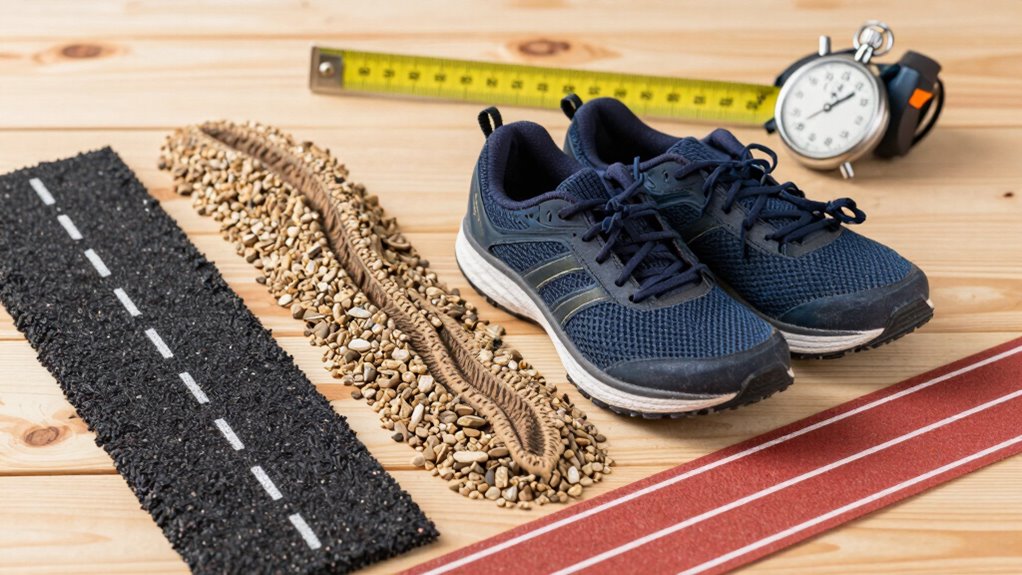
When you’re preparing for marathon training, understanding how your shoes match the terrain and run distance is essential.
For road surfaces, choose shoes with light, flexible uppers and supportive midsoles to cushion the impact on hard, even paths. A flatter outsole and a heel stack of at least 30 mm guarantee comfort over long durations.
Trail surfaces demand shoes with durable uppers, rock plates, and bigger lugs for grip and protection on uneven terrain types.
If you’re a heel striker, prioritize shoes with ample heel cushioning and drops around 8 mm to absorb impact. For midfoot or forefoot strikers, low-drop shoes with uniform cushioning work best.
Rotating shoe types helps maintain durability over extended training periods.
Selecting Shoes for Specific Marathon Goals
After verifying your shoes align with the terrain and distance, it’s time to focus on how they support your specific marathon goals.
Consider shoe flexibility and breathability factors as they greatly impact your overall performance. If you aim for speed, lighter shoes with responsive midsoles, like those with carbon plates or Pebax foam, can enhance propulsion.
For injury prevention, stability or motion control shoes help correct overpronation, essential for marathoners with specific support needs. Cushioning levels should match your footstrike; higher cushioning benefits heel strikers, while a lower drop suits mid-foot strikers.
Additionally, consider a medium-high heel-to-toe drop for ideal shock absorption. Evaluating these elements guarantees your shoes align with your personal marathon objectives, maximizing comfort and efficiency.
Wrapping It Up
Choosing the right long-run shoe for marathon training isn’t just about style; it’s your ticket to a more pleasant journey on race day. Consider your foot type, gait, and cushioning needs as your foundation. The shoe’s durability and fit should wrap your foot like a gentle embrace, ensuring comfort over countless miles. Match your shoe to your marathon goals and terrain, and you’ll be on your way to crossing that finish line with a smile.
My weekend long-run shoe starts feeling flat halfway through even though the outsole still looks okay, so I’m wondering what I should check first before replacing it again.
The foam usually gives out before the outsole looks worn, so the first thing to check is how the shoe feels underfoot near the end of a run. If it feels flatter, less springy, or starts making your legs work harder, that’s a sign the cushioning is no longer matching your mileage. For long runs, look for a shoe with enough cushioning for your pace and a fit that still feels comfortable when your feet warm up.