
Unlock your running potential with nine essential exercises to boost speed, strength, and resilience. Focus on Bent Knee Calf Raises for calf endurance, Weighted Plank Pull-Throughs for core stability, and Step-Downs for single-leg strength. Enhance hip and glute power with Hip Thrusts and Lateral Band Walks. Incorporate Hamstring Curls with Sliders, Inchworm Planks, and Banded Side Plank Clamshells for injury prevention and flexibility. Add Lateral Step-Up with Overhead Press to round out your regimen, revealing more benefits ahead.
Bent Knee Calf Raise With Forward Lean
When you’re looking to enhance your running performance and reduce the risk of calf strains, incorporating the Bent Knee Calf Raise with Forward Lean into your routine is essential.
This exercise primarily strengthens the soleus muscle, a vital component in propelling you forward while running. Most calf strains in distance runners occur in this muscle, so targeting it is crucial. Additionally, engaging in proper footwear selection can further reduce the stress on your calves and improve your overall running efficiency.
Recommended by physiotherapist Anh Bui, it’s advised to perform two to three sets of eight to 12 reps on both sides. You can seamlessly integrate this exercise before or after your runs, ensuring your calves are robust and resilient.
Weighted Plank Pull-Through
If you’re looking to enhance your core strength and stability, incorporating the Weighted Plank Pull-Through into your routine is a wise choice. This exercise challenges you more than basic planks by engaging deep core muscles and obliques through anti-rotational movements.
Suggested by running coach Britany Williams, it’s designed to fortify your core, making you a stronger, more resilient runner. Additionally, strengthening your core through exercises like this can significantly reduce the risk of injuries by improving muscle balance and addressing muscle imbalances that contribute to injury.
To perform, position a weight on one side, assume a plank, and pull the weight underneath to the opposite side. Aim for two to three sets of six to 10 reps per side, integrating it post-easy runs for optimal results.
Step-Down
Elevate your running game by incorporating the Step-Down into your routine. This exercise is a single-leg strength builder that closely mimics your running stride, offering more benefits than traditional lunges.
Start with bodyweight to master the form, then gradually add weights as you become more confident. Personal trainer Emily Abarquez recommends performing two to three sets of eight to 15 reps on each leg.
Ideally, integrate Step-Downs on non-running days, especially before rest days, to give your muscles ample recovery time. By mastering this move, you’ll boost your running efficiency and reduce injury risk, becoming a faster and stronger runner. Additionally, cross-training exercises can further enhance your overall fitness and resilience against injuries.
Hip Thrust
For runners looking to enhance their performance, incorporating the hip thrust into your strength routine can be a game-changer.
This exercise targets your glutes, the largest muscles in your lower body, which are crucial for generating speed and power. Unlike lunges and squats, hip thrusts are easier on your knees, reducing strain while still building strength.
Recommended by running coach Britany Williams, performing three to four sets of 10 to 12 reps once or twice a week can significantly boost your running efficiency.
Adding this exercise to longer strength sessions ensures a comprehensive approach to improving your running prowess.
Lateral Step-Up With Overhead Press

Incorporate the lateral step-up with overhead press into your routine to enhance your strength and coordination as a runner.
Start with a lower step, gradually progressing to higher platforms to challenge your balance and stability. This exercise, recommended by personal trainer Andres Padilla, involves stepping laterally onto a platform while simultaneously pressing a weight overhead.
Perform three sets of 15 to 20 reps on each side, focusing on maintaining proper form. This movement not only strengthens your legs and shoulders but also improves core engagement and overall body control, making it a valuable addition to your strength sessions.
Lateral Band Walk
While the lateral step-up with overhead press enhances strength and coordination, the lateral band walk offers a unique focus on preventing injuries by strengthening the glutes and hips.
To perform this exercise, place a resistance band around your ankles. Stand with your feet shoulder-width apart, maintaining slight tension in the band. Take five to seven small steps to one side, keeping your body upright and engaging your core.
Then, reverse the direction. Repeat this sequence five times. This exercise emphasizes lateral movement, often overlooked in running, which helps stabilize your hips and improves your overall running form and efficiency.
Hamstring Curl With Sliders
Engaging in hamstring curls with sliders is a fantastic way to target your hamstrings, core, and glutes, using your body weight as resistance.
To perform this exercise, place a pad, cloth, or sliders under your heels while lying on your back. Lift your hips into a bridge, then slide your feet away, extending your legs while maintaining control.
Return to the starting position by pulling your feet back toward you. This move is gentle on the lower back and knees, so you can include it on tough running days.
Aim for two sets of 10 reps to enhance your running strength.
Inchworm Plank
Transform your routine with the inchworm plank, an effective exercise that strengthens your core and glutes for improved running performance.
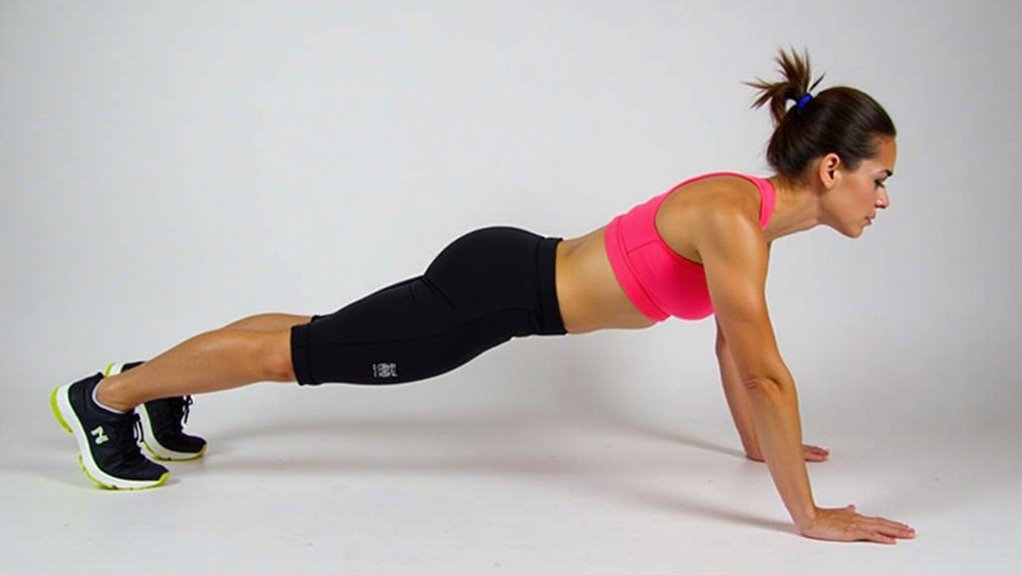
Begin by standing with your feet hip-width apart and folding at the waist. Walk your hands forward to reach a plank position. This movement targets your entire core and anterior chain while stretching your posterior chain, crucial for maintaining form and increasing running pace.
Perform five to ten repetitions or continue for 30 to 60 seconds. Incorporate the inchworm plank as an active warm-up before strength training or during high-intensity sessions to enhance overall running efficiency.
Banded Side Plank Clamshell
As you enhance your running efficiency with the inchworm plank, consider integrating the banded side plank clamshell into your routine for targeted hip power and stability.
This exercise strengthens your medial glutes, crucial for maintaining balance and preventing injuries. Start by placing a resistance band above your knees. Lie on your right side, lift your hips while keeping abs engaged, and open your thighs by lifting the top knee. Lower back down and repeat.
Perform two sets of 10 reps on each side. It addresses body imbalances and can be done as a warm-up or core workout on intense running days.
Conclusion
Incorporating these often-overlooked exercises into your routine will significantly enhance your running performance. By targeting essential but frequently neglected muscles, you’ll build strength, improve coordination, and boost stability. Exercises like the Bent Knee Calf Raise with Forward Lean and Weighted Plank Pull-Through help develop crucial muscle groups, reducing the risk of injury. Embrace this comprehensive approach to training, and you’ll become a faster, stronger, and more resilient runner, ready to tackle any challenge with confidence.
I’ve started getting that deep ache low in my calf on longer runs, and I only have room in my routine for one strength move right now. Should I start with the bent-knee calf raise for the soleus, or would one of the hip or core exercises help more with that specific fatigue?
Start with the bent-knee calf raise if that deep lower-calf fatigue is the main issue. That move directly targets the soleus, which does a lot of the work when you run for longer periods and is often the muscle that complains first. If you can only add one exercise for now, it makes sense to address the area that is already showing symptoms. Once that feels manageable, you can layer in hip and core work to support overall running mechanics and reduce the load on your calves.
I don’t have gym access at the moment, and I’m trying to keep my strength work at home after runs. If I skip the weighted moves, will bodyweight versions still give me enough stability work, or am I missing the point on this list?
Bodyweight versions can still give you a lot of the stability benefit, especially for exercises like step-downs, planks, hip thrusts, and side plank variations. The main thing is to keep the movement controlled and challenging enough that you feel your hips, core, and single-leg support working. Added load can help later, but it is not required to start building a useful base. If you are training at home, consistency and good form matter more than whether the exercise is weighted on day one.