

To build a 3-shoe rotation for injury resistance and better training, begin by selecting a shoe for specific workouts. Use a cushioned pair for recovery and long-distance runs to absorb impact. Choose a firm, lightweight shoe for speed work and enhancing ground feedback. Add a stability or zero-drop shoe for support and natural alignment. Regularly monitor wear and mileage to optimize their longevity. Keeping a diverse rotation not only reduces strain but also boosts overall performance. Explore the benefits further for more insights.
Understanding the Importance of Shoe Rotation
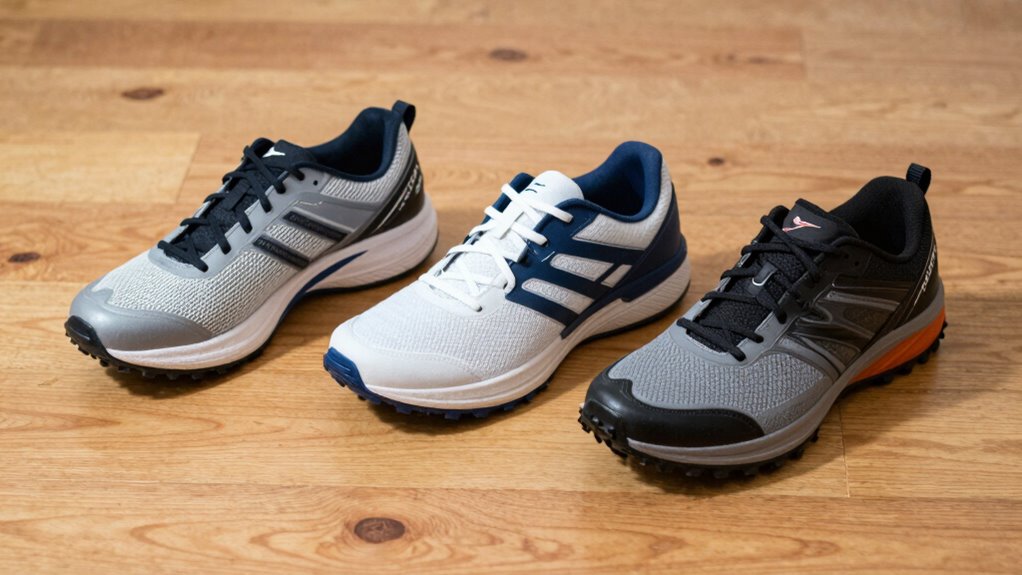
While it’s easy to overlook, rotating your shoes plays an essential role in maintaining your physical health and performance. By alternating between different pairs, you can considerably lower your risk of injury—by as much as 39%, according to a 2015 biomechanical study. The shoe benefits extend to injury prevention by altering loading patterns, which reduces repetitive strain. Different shoe designs shift stress across various muscle groups, helping to prevent overuse injuries. Additionally, varying stress distribution promotes a balanced physical response, ensuring ideal muscle and joint health. This practice effectively bulletproofs your feet and lower legs, challenging movement patterns and enhancing overall resilience. Incorporating strength training exercises not only complements shoe rotation strategies but also enhances muscle balance and reduces the risk of running injuries.
Selecting the Right Shoe Models for Varied Workouts
How do you choose the right shoe for your workout routine? Selecting the ideal shoe types depends on your workout intensity. For HIIT, opt for Nike Superrep Go for stability and lightweight foam, or Nike Zoom Superrep 4 for energy return and grip. Cross-training requires a wider base for side-to-side movements; Reebok Nano X5 and NoBull trainers offer breathability and flexibility. For weightlifting, prioritize shoes with raised heels like Nike Metcon 10 or NoBull Lifter for improved squat positions. When choosing running shoes, consider cushioning technology that absorbs impact and reduces strain on joints to enhance your workout experience.
| Shoe Type | Recommended Model | Key Features |
|---|---|---|
| HIIT | Nike Superrep Go | Stability, lightweight foam |
| Cross-Training | Reebok Nano X5 | Wider base, breathability |
| Weightlifting | Nike Metcon 10 | Raised heel, stability |
Choosing the right shoe enhances performance and reduces injury risk.
Balancing Cushioning and Firmness in Your Rotation
When building your shoe rotation, balancing cushioning and firmness is key to optimizing performance and reducing injury risk. Cushioned shoes absorb impact, making them ideal for long runs and recovery days, while firmer shoes enhance ground feedback, beneficial for speed work and form improvement. A well-rounded shoe rotation can also incorporate footwear like the HOKA One Women’s W Clifton 9, which provides a harmonious blend of style, comfort, and performance, ensuring both agility and elegance in your training regimen.
Cushion vs. Firm Shoe Benefits
Choosing the right balance between cushioned and firm shoes in your training rotation can greatly impact your performance and injury risk. Cushioning benefits include reduced peak impact acceleration and perceived forces during long runs, which can lower acute loading on your knees and hips. This helps minimize fatigue and form breakdown-related injuries. However, too much cushioning may alter gait mechanics and increase repetitive stress if your body doesn’t adapt. Firm support, on the other hand, provides stability and shortens contact time, promoting quicker shifts and reducing overload in faster efforts. It also helps control excessive pronation, maintaining alignment and reducing strain on soft tissues. Incorporating both cushioning and firm support in your rotation can optimize performance and injury resistance. Additionally, selecting shoes with advanced cushioning technologies like Amplifoam or Charged Cushioning can further enhance responsiveness and durability for long-distance comfort.
Optimal Cushion-Firm Balance
Finding the right cushion-firm balance in your shoe rotation can greatly enhance your training efficiency and injury resistance. Understanding cushioning types and firmness levels will help you select shoes for specific workouts. For easy runs, prioritize high shock absorption, while tempo runs benefit from firmer midsoles with better energy return. Midsole variations, such as dual-density designs, offer a balance between softness and firmness, aiding in a smooth shift from landing to propulsion. Consider flexibility metrics and stack height as they affect stability and comfort. Regular stretching routines are essential to maintain flexibility and prevent tight or weak muscles, which are linked to injuries.
| Key Metric | Consideration |
|---|---|
| Shock Absorption | High for easy runs |
| Durometer Hardness | Soft top, firmer base for balance |
| Stack Height | Higher for cushioning, watch stability |
| Energy Return | High for speed workouts |
| Flexibility | Balance with firmness for control |
Experiment with these factors to optimize your shoe rotation.
Adapting to Shoe Variability
Although it’s tempting to stick to just one pair of running shoes, adapting to shoe variability by balancing cushioning and firmness in your rotation can greatly impact your training efficiency and injury prevention.
Different shoe constructions alter your biomechanics, shifting joint angles and muscle recruitment patterns. By rotating shoes, you distribute stress across various tissues, reducing repetitive strain and injury risk.
To adapt effectively, use specific shoes for different sessions: firm shoes for stability and strength training, moderately cushioned ones for speed work, and highly cushioned shoes for recovery runs.
Implement adaptation strategies by gradually introducing new shoes, starting with short sessions and increasing duration over time. This varied approach promotes resilience and optimizes performance while managing tissue load and recovery.
Incorporating Zero-Drop and Stability Shoes

When incorporating zero-drop and stability shoes into your training regimen, it’s vital to understand how each type can benefit your overall performance and injury prevention.
Zero-drop shoes encourage a midfoot or forefoot strike, promoting natural foot alignment and enhancing proprioception—key zero drop benefits. They increase intrinsic foot muscle strength and improve balance, making them ideal for low-intensity runs or technique sessions.
Encourage natural foot alignment and strengthen intrinsic muscles with zero-drop shoes for enhanced balance and proprioception.
However, conversion protocols are important to avoid injury; start with short runs, gradually increasing duration.
Stability shoes, on the other hand, offer medial support, reducing excessive pronation and protecting joints from high impact forces.
Aligning Shoe Rotation With Cross-Training Practices
Effectively aligning your shoe rotation with cross-training practices is essential for maximizing performance and minimizing injury risk.
By alternating shoes and incorporating cross-training, you can enjoy various cross training benefits and guarantee shoe recovery.
Here’s how to do it:
- Alternate Running Shoes: Use different shoes on days separated by non-impact cross-training, like swimming or cycling, to give foam at least 24–48 hours to recover.
- Plan Cross-Training Sessions: Schedule non-impact activities after intense runs to decrease cumulative tissue stress while maintaining running-specific sessions.
- Include Cross-Training During Intense Weeks: Maintain fitness using biking or swimming during weeks with two hard runs to reduce repetitive stress.
- Double-Training Days: Assign one session to running shoes and the other to cross-training shoes to prevent compressing the same pair twice.
Monitoring Shoe Wear and Longevity
Aligning your shoe rotation with cross-training practices not only enhances performance but also sets the stage for understanding how to maintain your shoes’ longevity.
Start with regular shoe inspection to identify wear indicators such as uneven outsole patterns, which can reveal gait imbalances. Use compression evaluation to check midsole integrity; visible creasing often signifies declining shock absorption.
Mileage tracking is essential, with many shoes needing replacement between 300-500 miles. Consider asymmetry analysis by comparing shoes side-by-side for performance metrics.
To refine replacement strategies, integrate sensor data for impact assessment and monitor any changes in loading rates. Capture visual documentation after every 100-150 km to track shoe condition over time.
These steps guarantee you maximize both performance and safety.
Adapting Rotation to Personal Running Goals and Needs

To build a shoe rotation that aligns with your personal running goals and needs, it’s crucial to identify your primary training focus and select the most suitable shoes for each aspect of your regimen.
Consider the following steps to tailor your rotation:
- Determine your primary goal: Whether it’s marathon endurance, 5K speed, or injury rehab, choose the shoe that best supports the majority of your weekly mileage.
- Complement key workouts: Use a second shoe for specific sessions like tempo or intervals, ensuring these shoes are purpose-built.
- Fill gaps with a third shoe: Opt for a pair that aids recovery or enhances strength and adaptation.
- Reassess regularly: Every 4-8 weeks, evaluate your shoe roles to align with evolving training priorities and fatigue management for effective injury prevention.
Wrapping It Up
Just like the hero’s journey, your path to injury resistance and enhanced training hinges on the decisions you make, particularly in crafting a diverse shoe rotation. Select shoes that cater to varied workouts, balancing cushioning with firmness, and incorporating features like zero-drop and stability. Align your choices with cross-training practices, always monitoring wear. Adapt your rotation to meet personal goals, ensuring each step is well-supported. This thoughtful approach transforms your running experience, paving the way for success.
I already have a soft daily trainer and a lighter tempo shoe, but I’m not sure which one should be my default for easy runs versus moderate runs in my rotation.
Use the softer daily trainer for the easier days and keep the lighter shoe for workouts that ask for a quicker turnover. That usually gives you a clearer split between comfort and feel underfoot without overworking one pair. If the moderate run still feels relaxed, the daily trainer is the safer default; if you’re pushing the pace a bit, save the lighter shoe for that.