
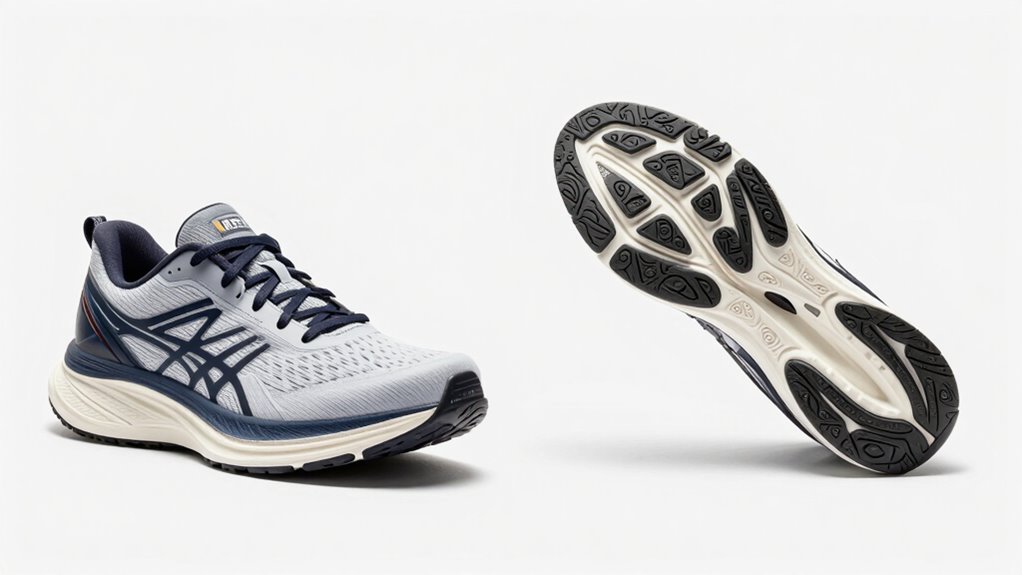
Two shoes might feel similar but perform differently due to variations in foam composition, rocker mechanics, and geometry. Foam types like EVA, TPU, and PEBA affect energy return and durability. The rocker profile influences foot movement and pressure distribution, while geometry, including stack height and heel-to-toe drop, impacts biomechanics and stability. Each aspect can alter performance, comfort, and response during runs. Understanding these factors will guide your selection and enhance your running experience.
Foam Composition and Midsole Chemistry
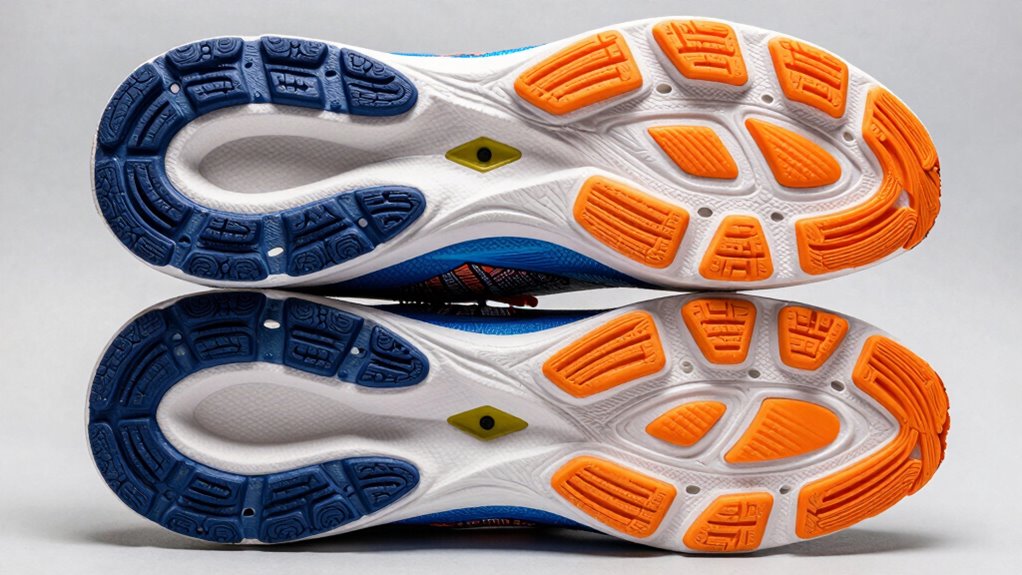
When it comes to running shoes, the foam composition and midsole chemistry play a pivotal role in how each shoe performs and feels. EVA variations offer a balance of cushioning levels and foam durability, with blends tailored for comfort and support. TPU enhancements provide impressive energy return and response quality, though they can be heavier, impacting weight differences. PEBA advantages shine with their lightness and superior energy return, though they may lack durability. Infused properties, such as nitrogen-infused EVA, enhance the foam’s response and resilience. Incorporating strength training exercises can further enhance a runner’s performance, providing injury prevention and improved running efficiency. Each material blend affects not only performance but also the overall feel of the shoe, allowing you to choose based on your specific running needs and preferences, optimizing your experience with varying cushioning and support.
Rocker Profile and Longitudinal Curvature
Understanding the rocker profile and longitudinal curvature is essential for recognizing how running shoes influence your stride and performance.
Rocker mechanics play a significant role in determining how your foot moves along the longitudinal axis. The apex position, found on this axis, influences pressure distribution across your foot. A forefoot apex at 50-60% of the shoe length reduces stress on metatarsal heads, while a 65% position eases pressure on the hallux.
Rocker radius also impacts your gait; smaller forefoot radii decrease peak dorsiflexion and plantarflexion moments, enhancing comfort and efficiency. The apex angle, ideally near 90°, works with the rocker to redirect forces.
Together, these elements shape the shoe’s curve, optimizing pressure distribution and your overall running experience. Additionally, the FF BLAST MAX cushioning system in the ASICS Women’s NOVABLAST 5 enhances the running experience by ensuring softer landings and responsive toe-off.
Plate Inclusion and Stiffness
Although many runners might overlook the importance of plate inclusion and stiffness in their shoes, these elements greatly impact your running performance. Curved carbon plates enhance plate performance by improving running economy by 3.45% compared to shoes without plates. Their curvature supports a natural rolling motion, while also minimizing forefoot pressure by up to 12.62%. Stiffness effects play a pivotal role too. With a forefoot stiffness of 0.89 Nm/°, these plates prevent active bending, demanding more muscle force for motion. High longitudinal bending stiffness (LBS) shoes increase stride length and contact time, impacting your biomechanics.
| Plate Type | Running Economy Improvement | Forefoot Pressure Reduction |
|---|---|---|
| Curved | 3.45% | 5.51%–12.62% |
| Flat | None | Lower than curved |
| No Plate | None | N/A |
Understanding these factors can optimize your performance.
Geometry: Stack Height, Heel-to-Toe Drop, and Structure
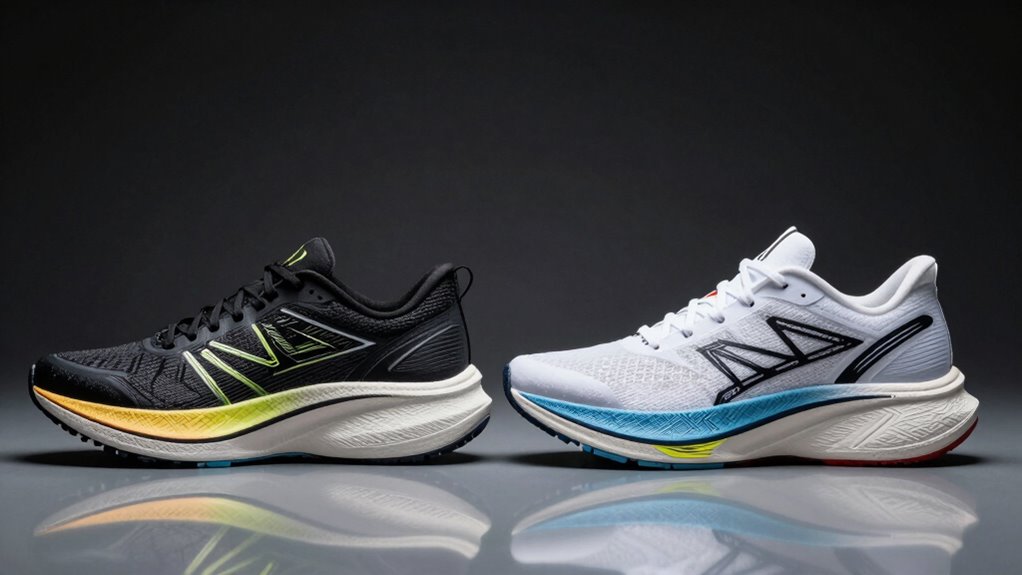
Plate inclusion and stiffness certainly enhance your running shoes, but geometry, including stack height, heel-to-toe drop, and structure, plays an equally pivotal role.
Stack height refers to the midsole/outsole thickness between your foot and the ground. It’s measured at the heel and adjusted for the forefoot by subtracting the heel-to-toe drop. Brands differ in measurement approaches, leading to varied values. Generally, medium stacks around 25–35 mm offer a balance of cushioning and responsiveness.
However, higher stacks can alter your running dynamics, increasing vertical oscillation and ground contact time. A well-cushioned midsole contributes to smoother transitions from heel to toe, enhancing overall stability and comfort. Heel-to-toe drop impacts your footstrike pattern; higher drops favor heel strikes, while low or zero drops encourage mid or forefoot contacts. Understanding these elements helps tailor your shoe choice for the best performance.
Shoe Mass and Its Interaction With Economy and Perception
When you consider shoe mass, it’s vital to understand how added weight affects your running economy and perception. Each additional gram can make your lower body work harder, impacting performance and altering your stride.
However, while lighter shoes can boost speed and efficiency, they might compromise cushioning, leading to a trade-off between weight reduction and adequate support.
Impact of Added Mass
The weight of your running shoes can greatly affect your performance and running economy. Even a small mass impact can lead to a performance slowdown and trigger various physiological responses.
For every additional 100 grams per shoe, your running economy worsens by roughly 1.11%. This extra mass forces your muscles to work harder, increasing your heart rate and energy cost, which can elevate your injury risk.
- Performance Impact: 3-km time trials slow by 0.78% per 100 g added.
- Physiological Changes: Heart rate rises markedly with an extra 50-100 g.
- Metabolic Cost: Each 100 g per foot increases metabolic cost by 1%.
- Injury Risk: Lightweight shoes for heavier runners raise injury risk threefold.
Consider shoe mass seriously, as it plays a vital role in optimizing your performance. Glycogen depletion can also negatively affect your running performance, so maintaining adequate glycogen stores is crucial for prolonged activity.
Weight Distribution Effects
Though it might seem subtle, how the weight of a shoe is distributed greatly influences your running performance and perception.
Weight penalties arise when mass distribution is imbalanced, particularly if more weight is concentrated at the forefoot. This setup increases the metabolic cost, making your run feel more demanding. The added mass at the forefoot leads to higher energy expenditure due to the greater moment of inertia, demanding more muscle work from your ankle dorsiflexors and plantarflexors.
As a result, you might perceive increased effort and reduced comfort, causing you to pace more conservatively. Shoes that distribute weight more evenly, or incorporate design features like carbon plates, can mitigate these effects, ensuring a more efficient and comfortable running experience. Additionally, carbon fiber Flyplate technology in shoes like the Vaporfly 4 enhances propulsion and efficiency, providing a dynamic edge for competitive runners.
Cushioning and Performance Trade-off
While weight distribution plays a pivotal role in how a shoe performs, cushioning introduces another layer of complexity in the running experience. You must consider the mass trade offs when looking for cushioning benefits.
Adding 100 grams per shoe can increase metabolic cost, affecting running economy, especially for trained runners. However, overly reducing cushioning to decrease weight might lead to increased muscular work and oxygen cost.
Balance is key, as highly cushioned shoes can improve running economy despite their mass. Consider these points:
- Moderately cushioned shoes may reduce oxygen costs, enhancing performance.
- Excessive cushioning can alter biomechanics, negating benefits.
- Individual factors like body mass and gait impact ideal cushioning.
- Synergistic designs combining cushioning with stiffness can enhance economy.
Finding your perfect balance requires experimentation.
Interaction With Individual Biomechanics and Surfaces
When choosing running shoes, consider how your unique biomechanics interact with foam and surface types.
Your gait, arch height, and pronation tendencies can greatly influence how different midsole materials perform, affecting both comfort and risk of injury.
Additionally, surface-specific dynamics mean that the same shoe might offer varying levels of support and efficiency on different terrains, highlighting the importance of aligning shoe choice with both your physical attributes and running environment.
Gait and Foam Compatibility
Understanding how gait and foam compatibility interact with individual biomechanics and surfaces is essential for selecting the right running shoes. Gait analysis helps identify how your footstrike patterns influence the dynamic loading on your body.
Foam compatibility affects how energy is absorbed and returned during each step, and how this aligns with your specific biomechanics matters. Even if two shoes feel the same initially, variations in foam compression and rebound can lead to different internal loads.
- Foam viscoelasticity: It changes with loading rate, affecting perceived cushioning.
- Footstrike patterns: They alter how impact is absorbed by the foam.
- Foam thickness and stack height: They interact with body mass and step frequency.
- Long-term foam fatigue: It leads to differing mechanical responses over time.
Surface-Specific Shoe Dynamics
Even though two running shoes might initially feel similar, their performance can differ considerably when interacting with various surfaces. Surface stiffness plays an essential role in this dynamic.
On harder surfaces, the ground reaction forces increase, altering energy absorption and impacting how shoes return energy to you. Softer surfaces like grass or sand dissipate energy, demanding more muscular work for stability and propulsion, which levels the playing field between shoes with different energy-return capabilities.
In addition, traction and shear forces vary with surface type, affecting your shoe’s grip and stability during movements like cutting or braking. Midsole geometry also interacts with surface compliance, influencing how your foot rolls over different terrains.
As a result, surface interactions can make two seemingly identical shoes feel worlds apart.
Runner-Specific Preferences and Sensory Thresholds
While every runner has unique preferences, understanding the role of sensory thresholds can illuminate why two shoes might feel different in action.
Runner feedback often highlights comfort perception as a key factor. Different levels of plantar sensitivity mean some runners prefer softer cushioning, enhancing their comfort. This variability in sensory feedback impacts how you perceive cushioning and comfort.
Psychophysical thresholds, like the Just Noticeable Difference (JND), play a significant role too, helping you detect subtle changes in cushioning.
Here’s what influences your shoe experience:
- Plantar Sensitivity Variability: Sensitivity affects comfort perception.
- Psychophysical Thresholds: JND measures minimum intensity changes.
- Mass Perception Thresholds: Shoe weight affects your ground reaction force.
- Individual Attitude Influences: Personal attitudes shape midsole preferences.
Choosing the right shoe involves understanding these factors.
Wrapping It Up
In the world of running shoes, appearances can be deceiving. While two shoes might feel the same initially, their performance can vary greatly due to factors like foam composition, rocker profile, and geometry. As the saying goes, “the devil is in the details,” and understanding these intricate elements helps you choose the right shoe for your unique biomechanics. Consider how shoe mass, stiffness, and structure interact with your running style, ensuring each step supports your stride efficiently and comfortably.
I’m looking at a plated daily trainer for my easy runs, but I’m not sure if the plate will actually help at that pace or just make the shoe feel a little stiff. Is that something I should worry about if most of my miles are relaxed?
A plate can still work for easy miles, but it changes the feel more than it changes the effort. If you want a softer, more natural step for slower runs, an unplated shoe is usually the safer pick; if you like a little more structure underfoot, a plated daily trainer may still feel fine. The key is how stable and comfortable it feels at your normal pace, not just how it sounds on paper.