
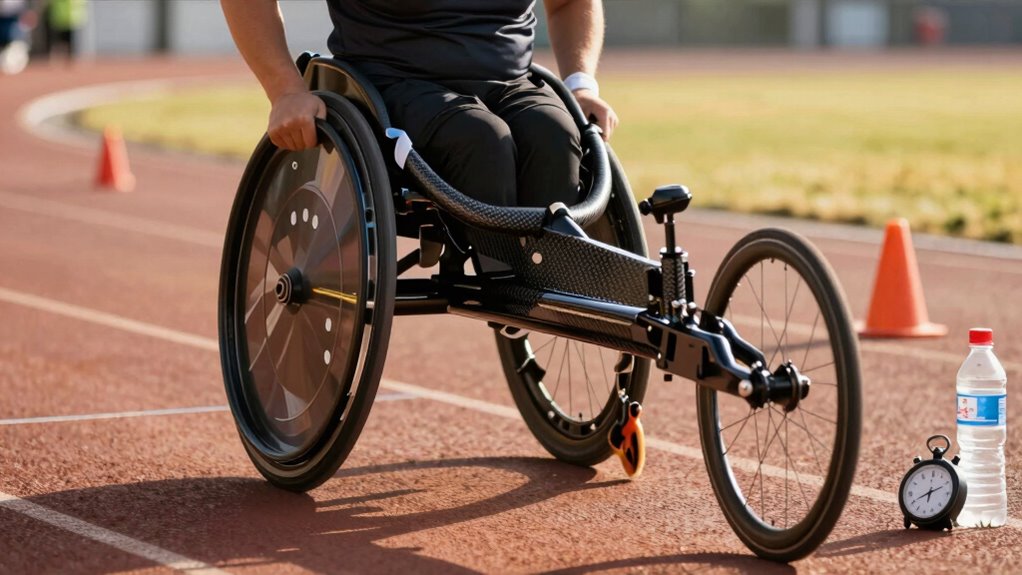
You’ll train endurance, speed, strength, and technique to race efficiently and stay durable. Fit your lightweight racing chair for power transfer, set camber and tire pressure, and carry spares. Practice the five push phases—contact, drive, release, lift, accelerate—plus starts, cornering, and drafting tactics. Follow a structured plan with recovery, strength sessions, and mobility work to prevent overuse injuries. Prepare mentally and plan nutrition and equipment checks, and keep learning more about competition preparation.
Wheelchair Racing 101: Who It’s For and Event Types

Wheelchair racing welcomes a wide range of athletes, from people with amputations or paralysis to those with vision loss, because classifications and equipment are designed to promote inclusivity and fair competition.
You can enter events that match your abilities and goals, from explosive 100m sprints to endurance marathons, and choose track or road formats that suit your strengths.
Minimum age rules, often set at 11 under IPC guidelines, encourage youth participation and progression through competitive ranks.
Local meets and major events like the Stoke Mandeville Grand Prix let beginners gain experience alongside elite Paralympians.
As part of adaptive sports, wheelchair racing offers structured pathways, clear competition formats, and classification systems so you’ll compete fairly while developing technique, strategy, and race-specific conditioning.
Wheelchair Racing Equipment: Chairs, Wheels, Helmet & Gloves
Equipment choices make a big difference in racing performance and safety, so you’ll want to understand how chairs, wheels, helmets, and gloves work together.
Your racing chair should be lightweight and custom-built, with a single front wheel and two angled rear wheels for stability and speed. Proper fit matters: position influences power transfer and injury risk, so get measured and adjusted professionally.
Your lightweight, custom racing chair—single front wheel and angled rear wheels—needs professional fitting to optimize power and reduce injury.
Choose a standard racing helmet that balances impact protection with low weight for comfort during longer efforts.
Gloves tailored to your grip preferences and prevailing weather improve control and pushing technique; try several styles to find what maximizes contact and reduces skin breakdown.
Carry spare racing and training wheels and an extensive tool kit to handle repairs quickly at events.
Set Up Your Racing Chair: Fit, Camber & Tyre Pressure
Get your seat position dialed in so your hips, backrest, and footrest let you transfer power efficiently without sacrificing comfort.
Adjust the camber of the rear wheels to match your cornering style and track conditions, and watch tire wear patterns for clues about alignment.
Keep tire pressure in the ideal range (usually 80–100 psi) to minimize rolling resistance and maintain consistent speed.
Optimal Seat Position
One precise setup can make a big difference: positioning your seat for ideal height, angle, and depth directly affects how efficiently you transfer power to the wheels. You’ll aim for a *best* seat position that supports a straight back, relaxed shoulders, and efficient leg extension so pushes are powerful and sustainable. Adjust seat height so your arms reach the pushrim without shoulder elevation; set depth to support hip stability without restricting leg drive; tilt seat angle to balance comfort and forward reach. Check footrest height to *enhance* push-and-glide mechanics and reduce injury risk. Use the table below to compare quick adjustments and expected effects.
| Adjustment | Target | Effect |
|---|---|---|
| Height | Arm reach neutral | Power efficiency |
| Depth | Hip support | Stability |
| Angle | Slight forward | Reach balance |
| Footrest | Leg extension | Injury prevention |
Camber And Tire Pressure
After you’ve dialed in seat height, angle and depth for power and comfort, the rear wheel camber and tyre pressure become the next adjustments that shape how your chair handles and rolls.
You’ll use camber to lean the rear wheels outward, increasing lateral stability and making turns more efficient. Tire pressure controls rolling resistance; keep it between 85 and 100 psi for best track performance.
Regularly inspect wear patterns and adjust accordingly to maintain control and comfort. Experiment with camber angles to match your push technique and body mechanics, and check tire pressure before every session.
- Adjust camber incrementally for predictable changes
- Check tire pressure with a reliable gauge
- Inspect tires for uneven wear
- Record setups and results
- Schedule routine maintenance
Push Technique: Contact, Drive, Release, Lift & Accelerate
Mastering the push technique means coordinating five precise steps—Contact, Drive, Release, Lift & Stretch, and Accelerate—to convert your upper-body effort into smooth, efficient propulsion. Your pushing technique relies on core strength and timing: make solid glove contact to start each stroke, drive with consistent rhythm while leaning forward, release quickly to reduce drag, lift and stretch to prepare, then accelerate into the next contact. Practice drills that isolate each phase and monitor timing to reduce wasted motion. In races, smooth shifts sustain speed and save energy. Maintain posture and breathing to support repeated drives. Below is a simple visual aid summarizing the phases and goals.
| Phase | Focus | Outcome |
|---|---|---|
| Contact | Solid grip | Stable start |
| Drive | Power, rhythm | Efficient push |
| Release | Quick removal | Reduced drag |
8‑Week Beginner Plan: Endurance, Speed and Strength Sessions
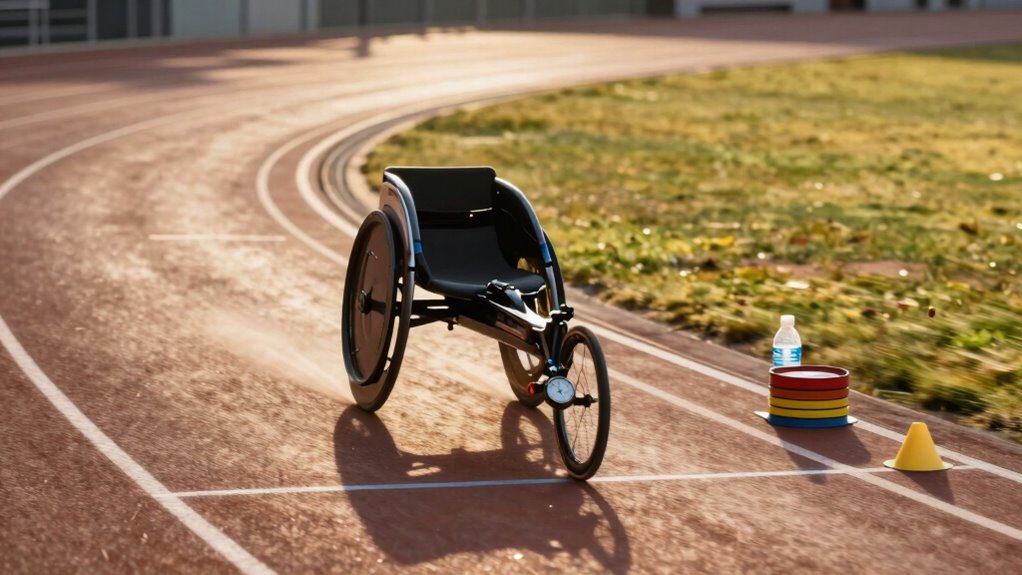
You’ll follow a simple weekly layout that mixes three endurance sessions, one focused speed interval workout, two strength days, and a technical push session to build fitness and efficiency.
For speed work you can alternate interval formats—short 30-second all-outs with longer rests or repeated 1-minute efforts with shorter recoveries—to train both acceleration and repeat sprint ability.
Balance those sessions with targeted upper-body and core resistance work, and schedule active recovery and careful progress tracking so you can adjust volume, intensity, and rest as you improve.
Weekly Training Breakdown
Plan your week to balance endurance, speed and strength so you build fitness while minimizing fatigue and injury risk.
Use a clear training plan that schedules endurance days, interval work, technique drills, strength sessions focusing on upper body, and recovery. Track intensity and adjust based on how you feel.
- Monday: 45–60 min steady endurance push at conversational pace, focus on push-and-glide rhythm.
- Tuesday: Technique drills—work through Contact, Drive, Release, Lift and Stretch, Accelerate.
- Wednesday: Upper body strength training with bands or weights, targeting shoulders, arms, core.
- Thursday: Interval speed session—short sprints (30–60s) with 2–3 min recovery repeats.
- Friday: Active recovery or easy mobility work;
- Saturday: mixed session;
- Sunday: full rest.
Speed Workout Variations
When you’re introducing speed workouts into a beginner week that already balances endurance and strength, vary the sessions so each targets a specific adaptation—top-end speed, repeatability, or power—while keeping overall fatigue manageable.
Use interval training with 30-second high-speed pushes and 1-minute recovery glides to develop speed and aerobic capacity; repeat sets with clear rest protocols and record times and distances to track progress.
Schedule hill sprints—30-second uphill pushes with controlled descents—to build power and refine technique without substituting separate strength sessions.
Designate speed days for consistent push-and-glide rhythm, targeting set distances like 400 meters and aiming for a time goal to measure repeatability.
These speed workout variations integrate fitness and skills development while informing progressive adjustments to your plan.
Strength And Recovery
Although balancing endurance and speed sessions is important, dedicating two to three focused strength workouts per week is essential for developing the upper-body power and muscular endurance that wheelchair racing demands.
You’ll prioritize exercises targeting shoulders, chest, triceps, and core to improve pushing strength and efficiency. Combine strength with structured endurance intervals and sprint practice to translate power into speed.
- Schedule 2–3 strength sessions weekly, using resistance bands, weights, and bodyweight movements.
- Use 2-minute hard/1-minute recovery intervals for endurance development.
- Add 30-second maximal sprints with full recovery to hone speed.
- Apply recovery techniques—stretching, hydration, and gentle mobility—after workouts.
- Include rest days to allow adaptation, prevent overtraining, and optimize performance through planned recovery.
Strength training also helps prevent common overuse injuries by improving muscle balance and tissue resilience, allowing athletes to better absorb the stresses of frequent pushing.
Race Skills & Tactics: Starts, Turns, Drafting and Race‑Day Strategy
Sharpening your race skills — from explosive starts to efficient turns and smart drafting — will give you a measurable edge on race day.
You’ll practice starts to develop quick acceleration and a strong push-and-glide rhythm that gets you up to speed immediately.
On course, efficient turns matter: lean into corners and use compensators to angle the front wheel, maintaining control and minimizing speed loss.
Drafting is a tactical tool; follow closely behind another racer to reduce wind resistance and conserve energy for decisive moves.
Your race-day strategy should include pacing, hydration, and nutrition plans tailored to the event distance and conditions.
Finally, prepare mentally—visualize success and use calming techniques to maintain focus and confidence throughout competition.
Care, Injury Prevention & Where to Find Support
Because your body and equipment work together, caring for both is central to staying healthy and performing well in wheelchair racing. You should keep your chair maintained—check tire pressure, bearings, and frame integrity—to prevent mechanical failures and support injury prevention.
Optimize seating position and alignment to reduce shoulder, elbow, and wrist strain. Follow a structured training plan that increases load gradually so your tissues adapt. Listen to your body and address discomfort early with rest, modification, or professional assessment.
- Regular wheelchair maintenance schedule
- Ergonomic seating and alignment checks
- Gradual, progressive training programs
- Prompt response to pain and recovery strategies
- Connect with local clubs (e.g., Achilles International) for resources and support
These steps protect performance and reduce injury risk.
Wrapping It Up
You’ve got the tools, techniques, and plan to start racing confidently; now test the theory that practice beats equipment every time. Regular, focused sessions will improve your push, endurance, and tactics more than chasing marginal gear gains. Keep your chair well‑set, prevent injuries, and learn racecraft through drills and local competitions. Stay consistent, track progress, and lean on coaches and peers—improvement comes from disciplined training plus smart preparation, not instant breakthroughs.