

When running downhill without straining your quads, focus on efficient biomechanics and strengthening exercises. Land your foot under your hips with a slight forward lean from the ankles. Engage core muscles and maintain an upright posture using a shorter stride. Include eccentric exercises like single-leg squats in your training. Start with gentle slopes, progressively increasing difficulty. Utilize recovery techniques including foam rolling and choose appropriate shoes for traction. Master these strategies for better downhill running.
Biomechanical Strategies for Reduced Quad Load

When you’re running downhill, optimizing your biomechanics can greatly reduce the load on your quadriceps, making your descent more comfortable and efficient.
Start by focusing on your foot strike; aim to land with your foot directly under your hips. This midfoot or slightly forefoot position minimizes braking forces and limits peak knee loading.
Land with your foot under your hips to reduce braking forces and limit knee strain.
Meanwhile, pay attention to your trunk alignment. A slight forward lean from the ankles—not the waist—helps shift your center of mass forward, allowing gravity to assist your movement.
Maintain an upright torso with a slight forward tilt to reduce rearward braking moments. These adjustments can redistribute joint contribution, favoring your hips and ankles over your knees, thereby easing the eccentric strain on your quads.
Strengthening Exercises for Eccentric Load Management
To effectively manage the eccentric load on your quadriceps during downhill running, incorporating specific strengthening exercises into your routine is essential. Focus on enhancing eccentric strength and quad endurance through exercises like eccentric single-leg box squats and Bulgarian split squats. These moves emphasize a slow descent, typically 3–5 seconds, to boost your quadriceps’ lengthening capacity and reduce muscle damage. Incorporate step-back lunges and heels-elevated goblet squats to mimic downhill braking and increase eccentric quad work. Eccentric single-leg heel lowers also isolate knee control, vital for shock absorption. Aim for 3–5 sets of 6–15 reps per exercise, adjusting tempo and load to suit your goals. Spread sessions across 1–3 times a week, ensuring adequate recovery to prevent excessive soreness. Consistent strength training leads to improved overall athletic performance and a lower likelihood of injury.
Progressive Training for Downhill Mastery
While mastering downhill running requires patience and strategic planning, progressive training is essential for developing both skill and resilience.
Begin with low-frequency hill descent sessions every 10–14 days to promote adaptive training and minimize muscle damage. Gradually increase the frequency to once every 7–10 days over 6–12 weeks, always monitoring soreness and performance.
Start with hill descents every 10–14 days, gradually increasing frequency while monitoring soreness and performance.
Limit initial downhill sessions to 20–30 minutes, increasing by no more than 10% every 2–3 weeks. Incorporate step-down weeks every 3–4 weeks by reducing downhill volume by 30–50% to consolidate adaptations.
Start on gentle slopes and gradually increase gradient difficulty as your control improves. Integrate mixed-surface progression to develop proprioception.
Schedule challenging downhill sessions when you’re fresh to focus on technique and limit fatigue.
Incorporating cross-training exercises into your routine can also enhance endurance and flexibility, providing a balanced approach to downhill running.
Running Technique Drills for Improved Motor Control

To improve your downhill running technique, focus on high-cadence drills and core stability exercises. High-cadence drills help increase your turnover rate, minimizing time spent in the air and reducing impact on your quadriceps. Core stability exercises strengthen your trunk and hips, promoting better control and alignment, which are essential for maintaining balance and reducing strain during descents. Additionally, incorporating specific running drills like high knees and butt kicks can further enhance your running mechanics, contributing to better speed and reduced injury risk.
High-Cadence Drills Focus
Engaging in high-cadence drills is an effective way to refine your running technique and improve motor control. By focusing on cadence benefits and rhythmic drills, you’ll enhance your efficiency and reduce the risk of injury.
These drills encourage a target of 180 steps per minute (SPM), promoting a midfoot strike and shortening your stride for peak performance.
- Skipping with Weights: Mimics running cadence, honing single-foot speed and control.
- Jogging in Place: Increases foot speed to target pace, enhancing rhythm mastery.
- Short Intervals: Builds higher turnover, attuning legs to quick steps over time.
Incorporating structured speed workouts into your routine is crucial for improved performance, combining high-intensity efforts with rest to boost both speed and stamina.
This focus on high cadence decreases impact forces and energy expenditure, improving running economy.
With consistent practice, you’ll experience smoother downhill runs, minimizing quad fatigue and enhancing overall endurance.
Core Stability Exercises
Having honed your cadence with high-speed drills, it’s time to focus on core stability exercises to enhance your running technique and motor control. Core engagement is vital for maintaining posture, balance, and efficiency during runs. Start with the Hollow-Body Hold and progress to Plank Variations and Anti-Rotation Drills to build foundational strength. These exercises are key in stability training, ensuring you maintain alignment and reduce injury risks. Gradual intensity increases in your workouts are important for preventing injuries commonly associated with overuse, such as Runners Knee and Shin Splints. Incorporating Dead Bug, Bird Dog, and Posterior Chain Activators will further enhance motor control and prevent lower back pain. These movements target deep core muscles, improving energy transfer essential for downhill running.
Recovery Techniques and Soreness Management

Incorporating a dynamic warm-up before your downhill runs can greatly reduce muscle stiffness and prepare your body for the eccentric demands ahead.
Following your run, focus on soft tissue recovery methods like foam rolling and massage to alleviate tension and enhance blood flow in your quadriceps and surrounding areas.
These practices not only aid in immediate recovery but also contribute to long-term muscle resilience, keeping you ready for your next downhill challenge.
Dynamic Warm-Up Benefits
While many runners may overlook the importance of a dynamic warm-up before hitting the trails, it’s vital for optimizing performance and mitigating the risk of soreness.
Dynamic flexibility exercises, when combined with a proper warm-up duration, increase muscle temperature and blood flow, priming your body for the demands of downhill running. This preparation helps reduce the strain on your quads and prevents injury.
Consider incorporating the following into your routine:
- Progressive Aerobic Activity: Easy jogging or brisk walking for 3–10 minutes elevates muscle temperature and enhances blood flow.
- Dynamic Drills: Brief movements (2–5 seconds each) like leg swings and lateral lunges without causing fatigue.
- Short Intensity Elements: Strides or hill efforts to activate neuromuscular timing for effective braking.
These steps guarantee a smoother, safer descent.
Soft Tissue Recovery Methods
Effective soft tissue recovery methods are essential for managing soreness and optimizing your running performance. Incorporating foam rolling into your routine can decrease leg soreness after downhill running.
By targeting areas like quads, IT bands, and glutes, you can reduce muscle tension and improve circulation, aiding muscle repair. Remember to roll slowly for at least 30 seconds per area, steering clear of joints and bones.
Active release therapy (ART) is another valuable method. It removes adhesions from repetitive micro-tears, preventing fibrosis and restoring pliable texture.
ART is particularly effective for addressing the root causes of overuse injuries, such as weak glutes leading to ITBS.
Choosing the Right Equipment and Footwear
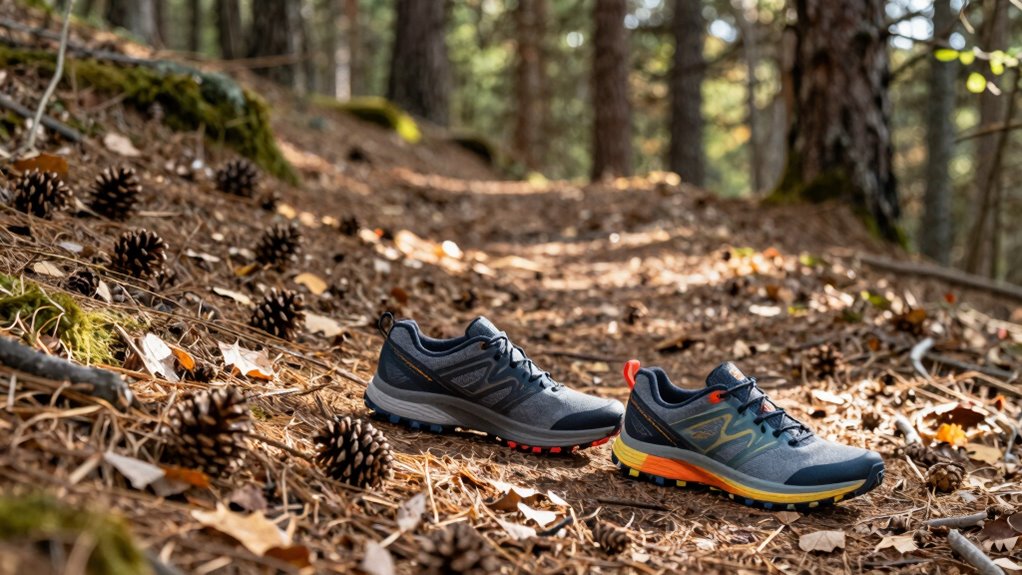
When tackling the challenges of downhill running, selecting the right equipment and footwear is essential for safety and performance. Trail running shoes, with their specific footwear features, are a key part of your equipment selection.
Opt for shoes with deep lugs and sticky rubber outsoles to guarantee maximum traction on varied terrains. Models like the La Sportiva Akasha II and Altra Lone Peak 9 offer reinforced toe boxes and cushioning to reduce pressure during descents.
Additionally, consider:
- Traction Devices: Attach these to your shoes for enhanced grip on snowy or icy trails.
- Running Poles: Use lightweight poles like Black Diamond Distance FLZ for increased stability.
- Socks and Gaiters: Compression socks and gaiters prevent debris entry, aiding comfort and support.
These choices help protect your quads and enhance your downhill experience.
Wrapping It Up
Embrace the art of downhill running, where every step mirrors a dance with gravity. By honing your technique, strengthening your muscles, and selecting the right gear, you’re crafting a symphony of movement that protects your quads. This journey isn’t just about speed; it’s about mastering control and resilience. With dedication to recovery and mindful training, you’ll glide over trails like a seasoned conductor, orchestrating each descent with finesse and preventing the harsh notes of pain.
I can keep my form together on shorter downhills, but on longer descents my quads start burning halfway through. Should I first focus on shortening my stride even more, or is it better to work on a higher cadence before I worry about anything else?
Start with a shorter stride and a slightly quicker cadence, but put the main emphasis on keeping your feet landing under your hips. That combination usually reduces braking and quad load more than stride shortening alone. If your cadence is already fairly quick, don’t force it higher just for the sake of a number; instead, keep the steps light, stay tall through the torso, and let the hill turn over your legs. On longer descents, that relaxed rhythm is usually what helps you avoid the late-race quad blowup.