
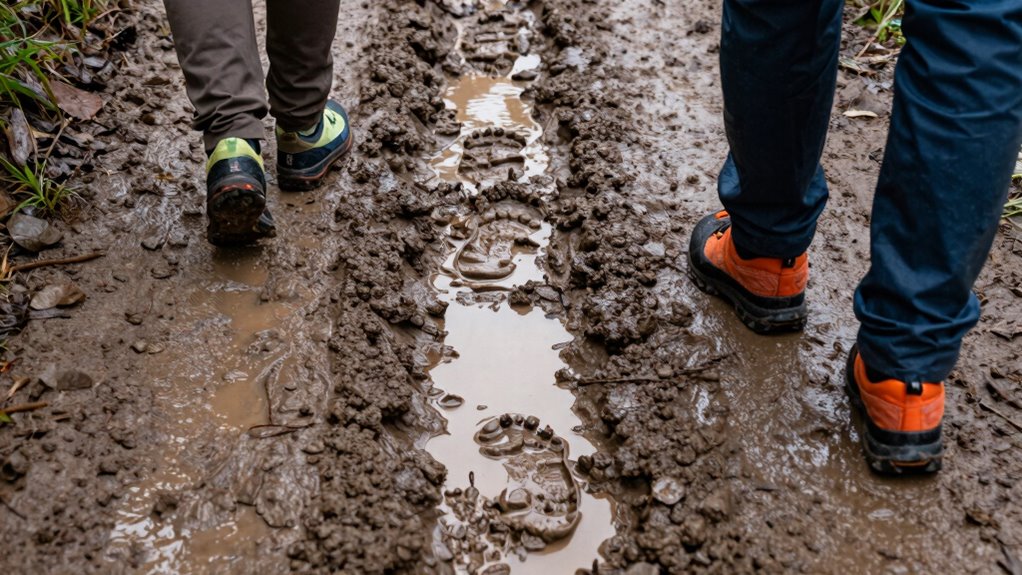
When tackling rain and mud trails, aim for firm lines at mud’s edges for better grip, keeping your stride short and close to your hips. Aim for a 180 steps per minute cadence to minimize sliding, and choose shoes with deep traction patterns like Salomon Speedcross 6 for excellent performance. Wear waterproof clothing, using GORE-TEX fabrics to protect against rain and mud. By focusing on these strategies, you’ll enhance your trail experience effectively. Explore further for optimized strategies.
Effective Grip Strategies for Muddy Trails
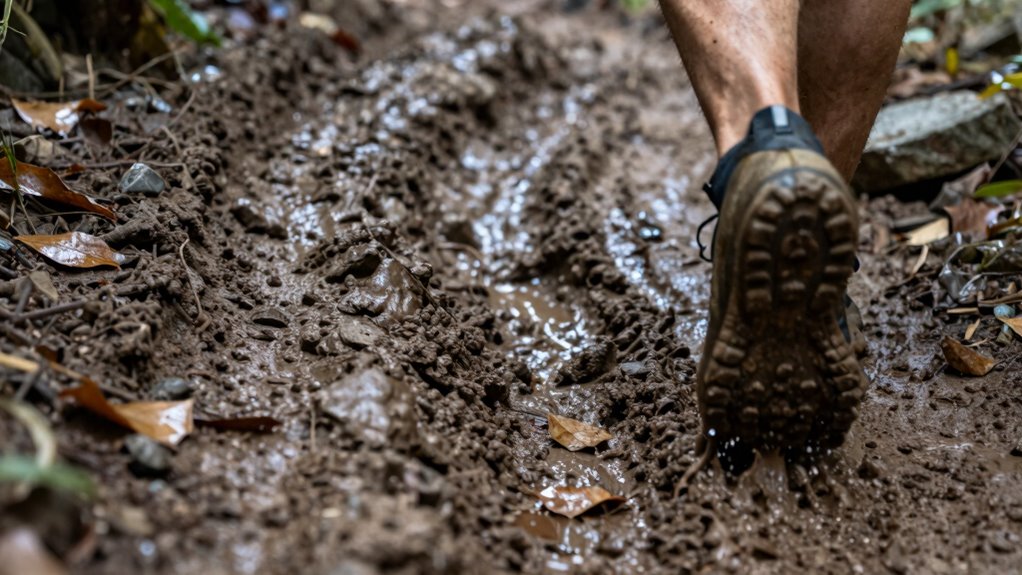
How can you assure ideal traction on muddy trails? Start by mastering foot placement and weight distribution. Aim for firm lines at the edges of mud, where compacted soil or vegetation offers better traction.
Keep your stride short, landing closer to your hips, engaging the lugs effectively. This approach maintains your weight over the center of gravity, enhancing stability.
On descents, lower your center of gravity by bending your knees and hips, which increases contact pressure at the forefoot and improves balance. Actively use your arms for counterbalance, especially when maneuvering tricky sections.
Shift your weight quickly if you slip, using light, rapid replanting to regain stability. These strategies assure you maintain grip and avoid falls in muddy conditions.
Mastering Cadence Techniques in Slippery Conditions
Mastering cadence techniques in slippery conditions can markedly enhance your stability and control on muddy or icy trails. Focus on quick cadence drills to help achieve an ideal target of 180 steps per minute. This reduces your ground contact time and minimizes sliding. By shortening your stride length and increasing step frequency, you maintain balance and prevent overstriding, especially on slippery downhills. Proper foot placement is essential; aim to land neutrally on your forefoot or midfoot to guarantee better control and reduce impact stress. Practice on smooth surfaces using a metronome app set to 180 bpm to refine your rhythm. As you shift to trails, concentrate on foot placement to stay agile and responsive, adapting to the terrain’s demands. Integrating strength training exercises into your routine can further enhance your running efficiency and help prevent injuries, providing better support for your runs under challenging conditions.
Optimizing Timing and Trail Selection for Wet Weather
Begin with thorough trail research to avoid paths that might suffer damage from wet conditions, like those on clay-heavy soils. Opt for rocky or loamy surfaces that handle moisture better, ensuring minimal environmental impact. Adjust your route to avoid waterlogged or muddy areas, sticking to familiar trails where you’re less likely to get lost. Timing is important; wait one or two days after heavy rains so trails have a chance to recover. This reduces your risk of steering through treacherous paths. Prioritize trails with good drainage, such as those on higher ground, and always check current weather conditions before heading out. Incorporating cross-training exercises into your routine can improve overall muscle strength and flexibility, reducing the risk of injury when navigating challenging terrains.
Choosing the Right Footwear for Traction and Comfort
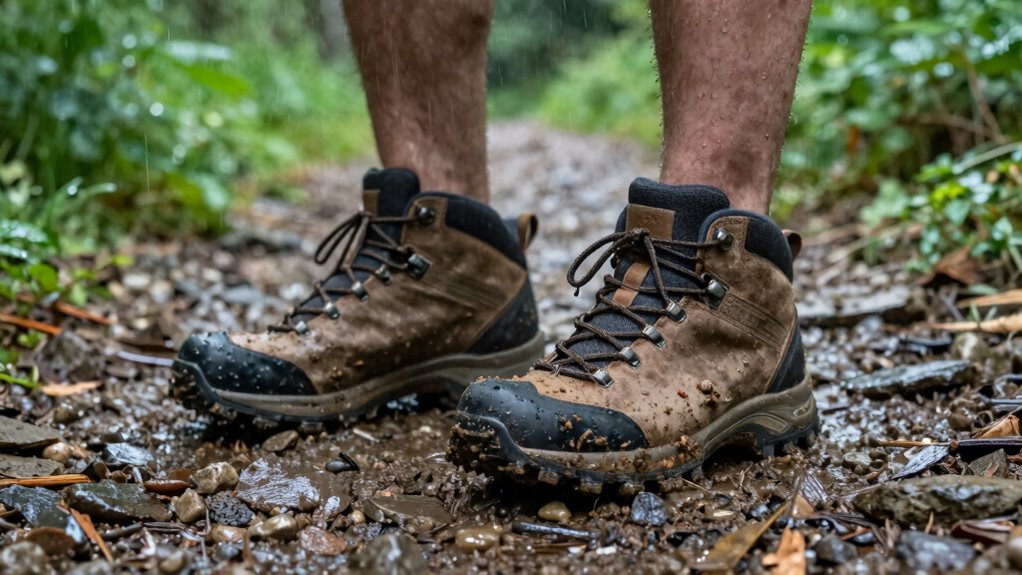
Selecting the right footwear for wet and muddy trails can make all the difference in your outdoor experience. For superior grip, prioritize footwear with deep traction patterns like the 5mm lugs, ideal for wet rock and muddy trails.
Footwear materials also matter; softer rubber outsoles offer a stickier grip, though they might wear faster. The Salomon Speedcross 6 stands out with its chevron-shaped lugs, effectively shedding mud.
If you’re facing extreme mud conditions, the Inov8 MudTalon Speed offers exceptional performance. For a balance of comfort and traction, the Hoka Speedgoat 6 and La Sportiva Mutant are excellent choices.
Consider the Vibram Megagrip outsole for versatile wet and dry surface grip. Incorporating cross-training exercises into your routine can improve overall fitness and prevent injuries, enhancing your trail running experience. Your choice should align with the terrain and your comfort needs.
Essential Clothing Selections for Mud and Rain Protection
To tackle wet and muddy trails effectively, you’ll need clothing that provides robust protection against the elements. Start with waterproof membranes like GORE-TEX for jackets and pants, making certain they’ve fully taped seams and waterproof zippers.
Moisture management is key, so choose breathable fabrics for your layering systems, including moisture-wicking base layers and suitable insulation options like synthetic midlayers.
Breathable fabrics ensure effective moisture management, with moisture-wicking base layers and synthetic midlayers providing optimal insulation.
Protective gaiters prevent mud and water ingress, while quick dry materials in pants reduce chill. For visibility gear, opt for bright outer layers or reflective trim.
Confirm your head and hands are covered with waterproof gloves and a brimmed hat, enhancing your grip and sightlines. These selections will keep you dry, comfortable, and visible in challenging conditions.
For additional safety, consider wearing a high-visibility running vest with 360-degree illumination to ensure you’re seen in low-light conditions while navigating through rain and mud.
Wrapping It Up
Now that you’re equipped with the knowledge to conquer muddy trails, the adventure awaits. Imagine each step, your feet gripping securely, your cadence steady and confident. You’ve chosen the right footwear and clothing, ensuring comfort and protection against the elements. The trail stretches before you, wet and challenging, yet inviting. Will you rise to the occasion, embracing the thrill of the unknown? The path is yours to explore—every decision preparing you for what’s just around the bend.
i’m heading into a wet section that’s gotten pretty churned up after last night’s rain. If the middle is soft but the edge looks more packed down, would you stay on the edge line even when it bends a little, or only do that if the mud is really deep?
Stay on the firmer edge line whenever it gives you a stable path, even if it means a slightly less direct route. That usually helps you keep traction and avoid the slipping that happens in the soft center. If the edge is narrow or awkward, shorten your stride and keep your feet landing closer under your hips so you can adjust quickly. On especially slick sections, it is better to sacrifice a little line efficiency than to force the mud straight on.