



To enhance your trail running, focus on foot placement drills like quick-step sequences and ladder drills to boost agility. Incorporate balance exercises such as single-leg stands and Romanian deadlifts to improve proprioceptive awareness. Strengthen with single-leg squats and plyometrics for power and dynamic cadence. Practice terrain-specific drills on rocky and slippery surfaces for better navigation. Prioritize mobility and recovery to reduce injury risk, and include neuromuscular priming before runs for peak performance. There’s much more to explore ahead.
Foot-Placement Drills


Foot-placement drills are essential for enhancing trail running efficiency and safety. You can improve your foot placement by practicing quick-step sequences like ladder drills, which train rapid and accurate directional changes. Incorporating visual coordination with these drills is vital.
Try the target-step drill, where you aim to land each foot precisely on marked targets such as stones or cones. This exercise enhances your visual-to-foot coordination, ensuring your feet adjust swiftly to uneven ground.
Additionally, directed downhill cadence drills can refine your controlled descents. Focus on placing each step under your body, using short, rapid strides to maintain stability. Incorporating dynamic warm-ups before starting these drills can further enhance muscle flexibility and prevent injuries.
Balance and Single-Leg Stability
To enhance your trail running skills, focus on improving proprioceptive awareness, which helps your body react more effectively to unpredictable terrain.
By strengthening lateral control through targeted exercises like single-leg glute bridges and Bulgarian split squats, you can reduce the risk of injury and improve force transmission during runs.
Additionally, building dynamic stability with drills such as single-leg Romanian deadlifts and perturbation training will prepare you for the varied challenges of trail running, ensuring you’re better equipped to handle sudden changes in terrain.
Incorporating strength training exercises like lunges, squats, and deadlifts can significantly improve performance and reduce injury risk, supporting a more resilient running routine.
Improving Proprioceptive Awareness
While trail running presents unique challenges, improving your proprioceptive awareness is essential for successfully maneuvering uneven terrains. Proprioceptive exercises enhance your body’s ability to sense position and movement, vital for tackling dirt, gravel, or sand.
By focusing on sensory feedback, you can boost your responsiveness and awareness, reducing the risk of injuries like ankle sprains. Here’s how you can improve:
- Single-leg stands: Start with your eyes open, then progress to closing them for added challenge.
- Balance boards and bosu balls: These tools enhance stability and coordination.
- Yoga stretches: They effectively challenge and improve your balance system.
- Barefoot training: This enhances foot sensory adaptation, making you more attuned to the terrain.
Incorporating drills like ABC Running Drills can also improve running efficiency and decrease injury risk, as they focus on proper technique and muscle strength. These exercises not only improve trail performance but also translate to better everyday stability.
Enhancing Lateral Control
Building on your proprioceptive awareness, enhancing lateral control is key for maneuvering the unpredictable nature of trail running. You’ll want to focus on lateral footwork to guarantee stability and agility when navigating obstacles on the trail.
Favor midfoot or slightly forefoot landings to keep your center of mass over your base of support, improving your responsiveness on uneven surfaces. Shorten your stride in technical sections to minimize lateral torque, and angle your foot placement toward the direction of anticipated lateral movement for increased traction.
Use quick, small steps rather than large crossovers for better balance. Additionally, adopt a wider arm posture to counterbalance and stabilize your movements during sudden lateral shifts, guaranteeing smoother runs even on challenging terrains.
Strengthening Dynamic Stability
Developing dynamic stability is essential for trail runners aiming to tackle uneven terrain with confidence and efficiency.
To enhance your dynamic control and single-leg stability, incorporate these stability drills into your routine:
- 100-Up Drill: Stand on one leg, replicating efficient running mechanics. Progress to jumping, focusing on balanced landings to build strength in your trunk, pelvis, and hips.
- Single-Leg Romanian Deadlifts: Perform 5-10 reps per leg, using lighter weights for balance. Advance to uneven surfaces to further challenge stability.
- Lunges for Stability: Practice forward and reverse lunges to enhance balance. Add dumbbells for increased resistance and mimic trail conditions.
- Squat-Based Balance Drills: Use a Bosu for squat holds to challenge your stability. Incorporate single-leg squats for intense trail stability improvements.
These drills help you absorb stress through stabilizers, not leg joints. Incorporating cross-training exercises can prevent overuse injuries and maintain a balanced fitness routine, promoting total fitness through a mix of aerobic, strength, and flexibility workouts.
Agility and Cadence Work
In trail running, agility and cadence work are essential for mastering rapid foot adjustments and quick turnover training.
By incorporating drills like short-interval high-cadence runs and ladder agility patterns, you can enhance your ability to maintain a dynamic cadence while traversing technical terrain.
These exercises not only improve your neuromuscular responsiveness but also help you efficiently modulate your cadence to adapt to changing trail conditions.
Rapid Foot Adjustments
Mastering rapid foot adjustments while trail running demands agility and a keen sense of cadence, essential components for tackling diverse terrains with confidence.
Implement these rapid response techniques and foot adjustment strategies to enhance your trail performance:
- Short Stride Adjustments: Use quick, short steps to maintain balance and agility. This guarantees better reaction time, especially on steep inclines, and helps prevent muscle strains.
- Light Foot Contact: Focus on midfoot strikes for smooth landings and quicker adjustments. This technique allows for faster pick-up speed and efficient form.
- Arm and Posture Drive: Keep arms swinging close to your body to maintain momentum and cadence. A good posture with a slight forward lean engages your glutes.
- Lateral and Directional Shifts: Practice side-to-side shuffling and small jumping motions to navigate uneven trails effectively.
- Effective hydration management is crucial for long trail runs to maintain endurance and prevent fatigue, ensuring that runners can maintain their agility and cadence throughout the course.
Quick Turnover Training
As you hone your ability to make rapid foot adjustments on the trail, it’s also important to focus on enhancing your foot turnover speed for improved agility and cadence. Quick feet drills, like short, fast steps, activate your quads and glutes, providing stability on loose terrain.
Practice forefoot landings to enhance reaction time, especially on technical sections. Repeating short slowing sections 5-6 times while accelerating each pass builds confidence.
Incorporate high knee drives during steep uphills to naturally shorten your stride, engaging your hips, glutes, and quads for ideal turnover. Use strides and fartlek training to improve uphill efficiency, alternating fast bursts with an easy pace to teach faster turnover.
Synchronizing arm-leg movements and increasing downhill turnover further refines your trail running skills.
Dynamic Cadence Modulation
Even though running on trails requires agility and quick thinking, mastering dynamic cadence modulation is an essential skill that enhances your performance and reduces the risk of injury.
To achieve effective cadence synchronization and rhythm adjustment, incorporate these techniques into your routine:
- Use a Metronome: Set it to 180 steps per minute to improve your cadence sustainably, aligning with elite runners’ cadence standards.
- MP3 Audio Files: Play specific BPM tracks through VLC to dial in your target cadence, like 175 or 182, for varied pacing.
- Forward Engagement Focus: Lean slightly forward to minimize overstriding and optimize hip utilization for efficient forward propulsion.
- Plyometric Drills: Practice high knees and cross-over hop drills to build strength and reinforce cadence feel, ensuring stability on technical terrain.
Strength and Power for Technical Demands

Although trail running presents unique challenges, building strength and power is essential for maneuvering its technical demands.
Developing unilateral strength through exercises like single-leg squats and Bulgarian split squats helps balance your body, allowing for smoother navigation over uneven terrain.
Explosive power is equally important, enhancing your agility and responsiveness. Incorporating plyometric drills such as box jumps or lateral bounds boosts your ability to adjust swiftly to changing surfaces.
Don’t overlook your posterior chain either; exercises like deadlifts and Romanian deadlifts strengthen your glutes and hamstrings, vital for ascents and descents.
For uphill propulsion, focus on single-leg calf raises to fortify your ankle strength.
Terrain-Specific Practice Sessions
When tackling trail running’s varied landscapes, it’s crucial to tailor your practice sessions to the specific terrains you’ll encounter. Customizing your drills helps you master obstacle navigation and terrain adaptation, ensuring you’re ready for any challenge.
Tailor your training to the terrain to master navigation and adaptation for any trail running challenge.
Start with dynamic warm-ups to prime your agility, then focus on specific features:
- Rocky terrain: Practice pick-and-place footwork with short, repeated efforts to master landing on flat surfaces.
- Rooty trails: Train with controlled downhill shuffles and midfoot landings, reducing slip risks.
- Loose scree: Use short, cautious runs with a high cadence and toes-up posture to navigate edges.
- Mud/slippery surfaces: Perform slide-and-recover drills, starting slow and increasing tempo to refine control.
These targeted sessions enhance your technical skills and confidence.
Mobility, Recovery, and Injury-Prevention
To maximize your trail running experience, it’s important to prioritize mobility, recovery, and injury prevention. Incorporating mobility routines, like hurdle drills and steeplechase exercises, enhances your flexibility and reduces injury risks such as runner’s knee and plantar fasciitis. Daily mobility routines practiced by elite runners improve stride mechanics and running economy. For recovery strategies, focus on balancing training intensity with rest to prevent muscular breakdowns common in trail running. Effective recovery also includes tailored strength and stability exercises to maintain joint range of motion.
| Aspect | Benefits |
|---|---|
| Mobility Routines | Improve flexibility, reduce injury risk |
| Recovery Strategies | Balance intensity, prevent breakdowns |
| Hip Mobility | Reduces runner’s knee risk |
| Ankle Mobility | Prevents plantar fasciitis |
| Strength Training | Enhances running economy |
This approach promotes a smoother, injury-free trail running journey.
Pre-Run Neuromuscular Priming
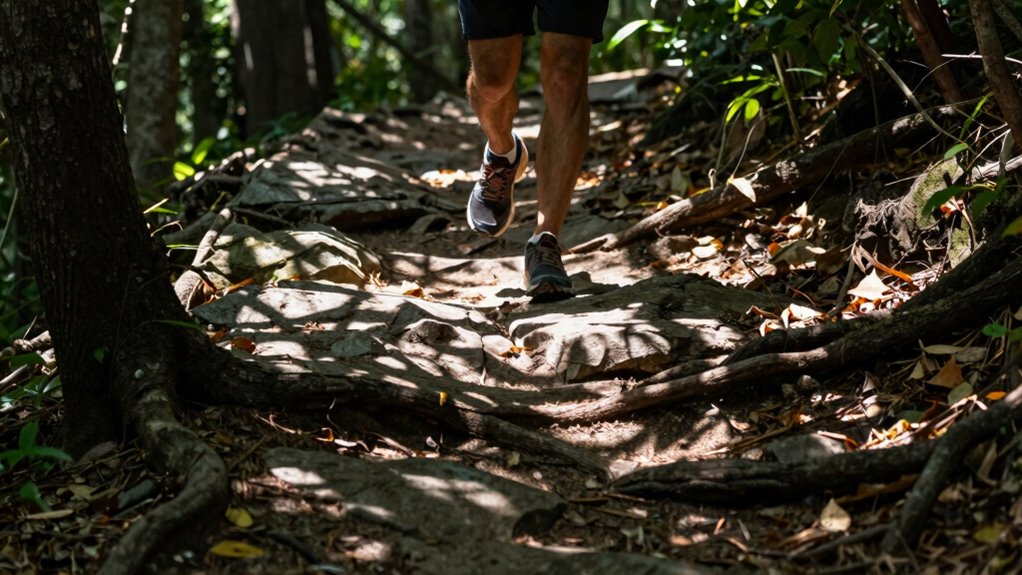
Maximizing your trail running experience involves more than just preventing injuries and improving mobility; it also requires preparing your body for peak performance through neuromuscular priming.
By engaging in specific priming protocols, you enhance neuromuscular adaptation, ensuring prime readiness on the trail. Here’s how you can incorporate effective strategies:
- Heavy Load Resistance: Perform 2 sets of half squats at 87% 1RM to improve voluntary activation and torque development.
- Sprint Priming: Execute running-based sprints for enhanced performance, with a 5-6 hour prime recovery window.
- Dynamic Warm-Ups: Include short jogs with strides faster than race pace to increase brain-body readiness.
- Hill Workouts: Integrate the “Hill Beast” session 10-14 days before races for neuromuscular benefits.
These methods prepare your body for the demands of trail running.
Wrapping It Up
Incorporating footwork drills into your trail running routine can greatly enhance your performance and safety. Did you know that a study found runners who practiced balance and agility drills reduced their risk of injury by 25%? By focusing on foot placement, stability, and agility, you’ll navigate technical terrain with confidence. Don’t overlook the importance of strength, mobility, and pre-run priming, as these elements work together to guarantee a smoother, more enjoyable trail running experience.