
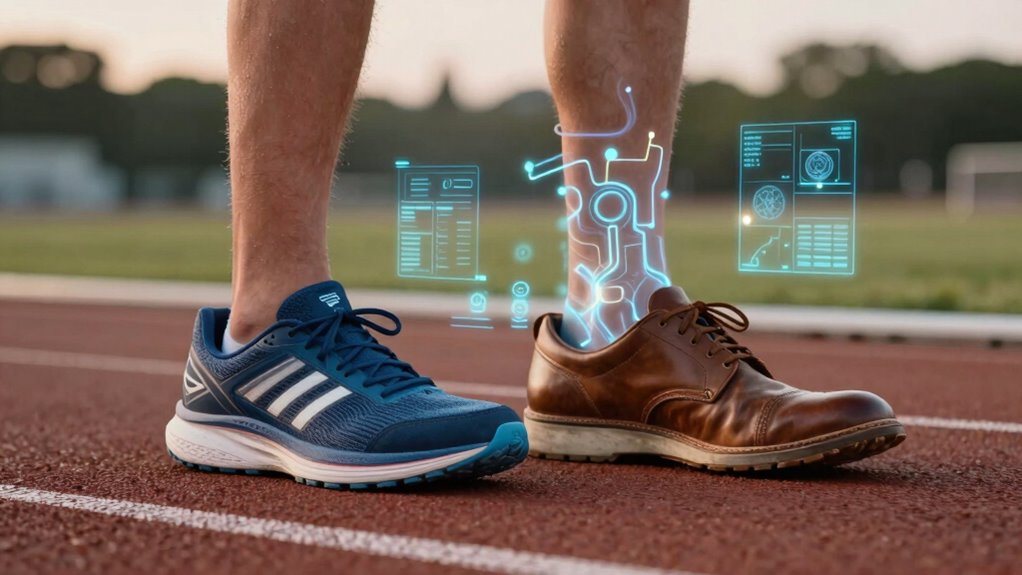
You’ve seen how technology reshaped running: better shoes, synthetic tracks, precise timing, and smart wearables that boost economy and safety. Innovations from vulcanized rubber and waffle soles to foam, carbon plates, and 3D printing improved cushioning, traction, and energy return. Photo-finish and chip timing guarantee fair results while GPS and sensors guide training and injury prevention. Sustainable materials and virtual races broaden access and reduce waste. Keep going and you’ll uncover specific advances, impacts, and future trends.
Why Running Tech Matters: Key Turning Points and Benefits
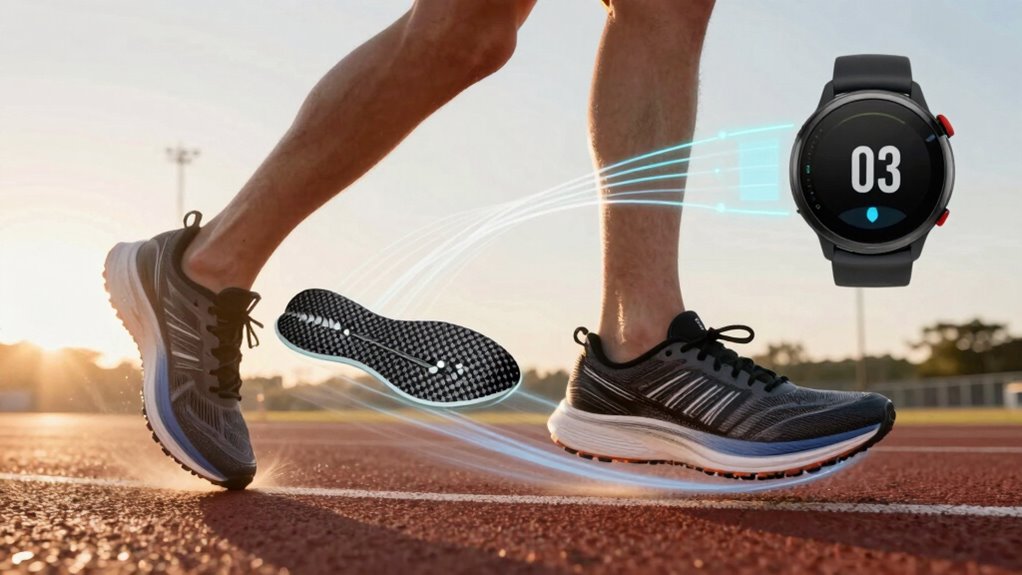
Although running has always been a test of human endurance, technological advances have repeatedly reshaped what athletes can achieve and how events are run.
You see key turning points—from vulcanized rubber soles improving grip and comfort to synthetic tartan tracks offering consistent surfaces—that directly influence daily training and competition.
Technology in running shoes now includes Advanced Footwear Technology and PEBA foams, which can improve running economy by 2.8–4.2%, delivering enhanced performance you can measure.
Timing innovations, like photo finish systems and chip timing with RFID, guarantee fairness and scalable event management so your results are accurate.
These developments also support injury prevention through better traction, cushioning, and predictable track responses, helping you train smarter and race more safely.
Assessing your own feet and gait—through simple checks like the wet test and observing wear patterns—can guide whether you need stability shoes or neutral options for better performance and injury prevention.
Shoe Evolution: From Leather to Foam to Carbon Plates
When you trace the history of running shoes, you see a clear progression from heavy, leather-bound designs that prioritized durability to highly engineered platforms focused on cushioning, stability, and energy return.
You move from early 1900s leather shoes that offered minimal padding and frequent injuries to the 1960s innovations—like the waffle sole—that improved traction and basic cushioning.
In the 1970s, foam and gel materials expanded shock absorption and comfort, tailoring shoes to varied gaits.
In the 1970s, foam and gel transformed cushioning, enhancing shock absorption and adapting shoes to diverse gaits
The 1980s introduced motion-control features for overpronators, adding stability elements to reduce injury risk.
Recent 2010s advances, including 3D-printed soles and carbon plates, emphasize responsive cushioning and energy return.
These technology-driven changes consistently aim to boost your performance while reducing injury.
Modern designs also integrate advanced foam compositions and geometry to fine-tune energy return and ride characteristics.
Track Surfaces: The Switch to Synthetic and Performance Effects
You’ve seen how tracks moved from uneven dirt to the springier Tartan surfaces introduced at the 1968 Olympics, and that shift changed how athletes run and records fall.
Synthetic polyurethane-and-rubber tracks give you far better traction, consistent footing in varied weather, and measurable energy return that reduces fatigue and improves economy.
Because these surfaces are durable and standardized worldwide, they let you compare performances across venues and have helped broaden the sport’s accessibility.
From Dirt To Tartan
Because track surfaces directly affect traction, energy return, and injury risk, the shift from dirt and grass to synthetic “Tartan” tracks in the late 1960s represented more than a change in materials—it transformed how athletes trained, competed, and measured performance.
You witnessed inconsistent timing and greater injury variability on natural surfaces; Tartan, introduced at the 1968 Mexico City Olympics, gave you a durable, bouncy alternative. Made from polyurethane and rubber, synthetic tracks improved grip and consistency, contributing to a surge in world records and clearer biomechanical advantages.
Standardized surfaces worldwide let you compare performances more fairly and encouraged broader competition. The change also pushed running shoe brands to adapt, integrating technological innovations that complemented synthetic track properties and advanced athlete preparation. This shift also coincided with running’s broader cultural evolution from primal activity to organized sport, reflecting its role in civilization growth and athletic tradition.
Traction And Energy Return
Having moved from the era of dirt and grass to engineered Tartan surfaces, it’s important to examine how traction and energy return reshaped performance.
You’ll notice synthetic tracks made from polyurethane and rubber give consistent, bouncy footing that translates into faster times and many world records since the 1968 Mexico City Olympics. Improved traction helps you accelerate and corner with confidence while enhanced energy return returns more of your stride’s force, boosting efficiency.
Research shows these surfaces lower impact forces on joints, which reduces injury risks compared with older, less forgiving ground. Standardized track technology also makes performance comparisons fairer across venues, so when you train or compete on modern surfaces you benefit from both measurable gains and a safer, more predictable platform.
Many runners also lower their overall injury risk by combining modern surfaces with strength training and gradual progression in their training plans.
Weather Resistance And Consistency
While variable weather once turned tracks into unpredictable challenges, the switch to synthetic surfaces has largely removed that uncertainty and made performance more reliable.
You benefit from weather resistance that keeps footing stable in rain or sun, unlike older dirt or grass that compacted, rut, or turned slippery.
Synthetic tracks—made of polyurethane and rubber—deliver standardized traction and a springier feel that improved running efficiency and helped produce records after their widespread adoption.
Because surfaces are uniform, you can compare times globally with greater confidence, and coaches can design training without accounting for surface variability.
Injury risk from uneven ground falls, too, so both amateurs and professionals get safer, more consistent conditions that support sustained performance consistency and measurable progress.
Real-time feedback from wearable devices like GPS watches further enhances training by providing immediate data on pace, distance, elevation, and heart rate.
Timing and Finishes: Photo-Finish Cameras to Chip Timing

You’ll see how photo-finish cameras transformed outcomes by capturing thousands of frames per second to settle tight races with photographic precision.
Chip timing then reshaped event management using RFID transponders on bibs to automate accurate timing and provide real-time split and tracking data.
Together, these systems bolster race integrity, streamline logistics for large fields, and make competitive and mass-participation events fairer and more accessible.
Photo-Finish Precision
Although finishes once relied on human eyesight and stopwatches, the arrival of photo-finish cameras and, later, chip timing transformed how races are decided and managed.
You’ll see that the first use of photo finish technology at the 1912 Stockholm Olympics began a shift toward objective race timing, and its first official decision in the 1932 London Olympic 100m demonstrated the method’s power to resolve disputes.
Today’s photo finish systems use high-speed cameras capturing thousands of frames per second, delivering frame-by-frame evidence that officials can review.
That modern technology raises standards for fairness and accuracy, helping organizers publish results quickly and confidently.
While chip timing later expanded capabilities further, the photo finish remains central to definitive sprint outcomes.
Chip Timing Revolution
As chip timing emerged in the 1990s, it rapidly transformed how races are timed and managed by replacing manual methods with automated RFID-based systems that attach transponders to bibs and read them via antennas positioned at start, split, and finish points.
You’ll find chip timing has made accurate timing routine for events of any size, removing human error and enabling reliable split data. With RFID technology, organizers can track thousands of runners simultaneously, publish real-time results, and improve course logistics.
Athletes benefit because every participant, from elite to first-timer, receives precise results tied to their actual start and finish. Combined with photo-finish for close decisions, chip timing has professionalized race operations and broadened access to fair, verifiable competition.
Race Integrity Systems
Having automated split and finish times with RFID chips reshaped large-scale race logistics. Organizers also turned to optical systems to settle the closest, most contested outcomes.
You’ll find race integrity systems now blend chip timing with a modern photo finish to produce indisputable results. Photo-finish cameras, in use since early Olympic days and refined to capture thousands of frames per second, let officials resolve finishes to fractions of a second.
Chip timing, introduced in the 1990s, records each runner’s passage automatically, reducing human error and simplifying mass-participant management. Together these technologies streamline event operations, guarantee fair competition across all levels, and provide transparent evidence when placings are disputed.
Embracing both electronic and visual records safeguards accuracy and trust in race outcomes.
Running Tech: Wearables and Smartwatches for Training
When you strap on a modern smartwatch or fitness watch, you get more than a timepiece—you get a continuous stream of training data that can shape how you run.
Wearable technology delivers real-time performance metrics—heart rate, pace, distance, and calories—that let you adjust effort and structure workouts with intent.
GPS-enabled devices map routes and reveal pace patterns, so you can analyze segments and refine strategies over weeks.
Map your routes and spot pacing trends to analyze segments and sharpen your strategy over weeks.
Advanced features like VO2 max estimates and recovery-time suggestions help you plan intensity and rest.
Integration with apps such as Strava fosters community, competition, and data sharing.
Biomechanics and Injury Prevention: Tools That Help Runners Stay Healthy
Prevention starts with understanding how your body moves, and modern biomechanical tools give you that understanding in measurable detail. You can use motion capture and dynamic pressure mapping to spot gait inefficiencies and force imbalances, which lets you target interventions that cut injury risk by up to 50%. Wearable technology supplements lab data with real-time pace, heart rate, and training-load metrics so you can avoid overtraining and tune recovery. Advanced footwear with cushioning and carbon plates further reduces impact forces and improves economy, lowering stress-injury chances. Data analytics ties all inputs together, guiding progressive training plans and shoe choices.
| Tool | Purpose | Benefit |
|---|---|---|
| Motion capture | Analyze gait | Tailored corrections |
| Pressure mapping | Foot force distribution | Better shoe fit |
| Wearables | Real-time load | Injury prevention |
Virtual Racing and Apps: How Tech Builds Community and Competition
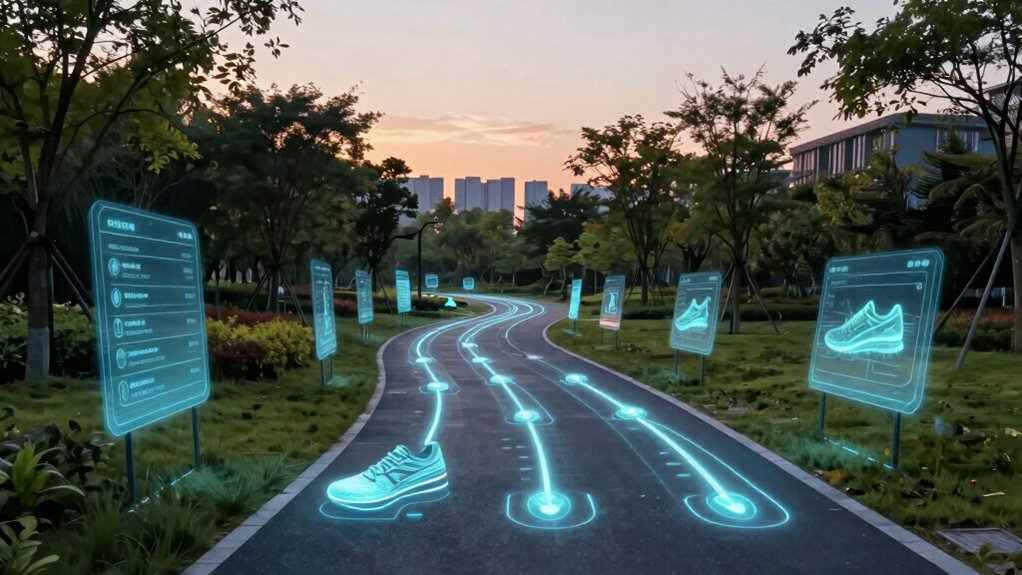
While virtual racing platforms connect runners across miles and time zones, they do more than just record times—they create structured spaces for competition, accountability, and community.
You can join global events that democratize racing, letting amateurs compete alongside seasoned runners without travel barriers. Apps like Strava and Runkeeper let you track progress via segment leaderboards, monthly challenges, and detailed activity logs, which heighten motivation and goal-setting.
Engagement data shows many users enter multiple virtual events annually, signaling sustained interest and social commitment. Even when you’re training solo, virtual reality features and shared metrics recreate social cues, making your running experience more interactive and competitive.
These tools build supportive networks, foster camaraderie, and expand access to organized racing for diverse participants.
Sustainability and Materials: Recyclable Shoes, Graphene, and Circular Design
As runners and manufacturers face increasing pressure to reduce environmental impact, sustainable materials and circular design are reshaping how shoes are conceived, made, and retired.
You’ll see sustainability push brands to rethink every component: midsoles, outsoles, uppers and adhesives.
Adidas’s FutureCraft Loop shows how recyclable shoes can return to production instead of landfills, embodying circular design principles that treat lifecycle management as core engineering.
At the same time, innovative technology such as graphene-enhanced rubber improves durability and flexibility, letting you run longer before replacing footwear and reducing waste.
Manufacturers are responding to consumer demand by integrating recycled content and designing for disassembly.
This shift balances performance with environmental responsibility, encouraging practices that make running gear both high-functioning and easier to recycle.
What’s Next: AI Coaching, Personalized Gear, and Emerging Materials
Sustainability-driven changes in materials and circular design are already reshaping how shoes are made and retired.
Now, technology is poised to reshape how you train and what you wear. AI coaching will analyze your pace, cadence, and recovery to create adaptive training plans that respond to fatigue, injury risk, and goal progression.
Technology will reshape training and gear: AI coaching analyzes pace, cadence, and recovery to craft adaptive, injury-aware plans.
Personalized gear, enabled by 3D printing, will produce custom-fit shoes that match your foot shape and gait, improving alignment and lowering injury likelihood.
Emerging materials like graphene rubber and PEBA foam will deliver better energy return, durability, and flexibility, enhancing performance while supporting longer product life.
Together, AI coaching, personalized gear, and advanced materials promise a more efficient, safer, and more sustainable future for runners.
Wrapping It Up
You’ll see how technology has reshaped running—from shoes and surfaces to timing and training—and why it matters for performance and injury prevention. Consider this: carbon‑plate shoes helped numerous athletes cut seconds off marathon times, contributing to a roughly 2–4% improvement in elite marathon performances since their introduction. As you embrace wearables, AI coaching, or sustainable materials, use data thoughtfully to personalize training, reduce injury risk, and choose gear that fits your goals and values.
