
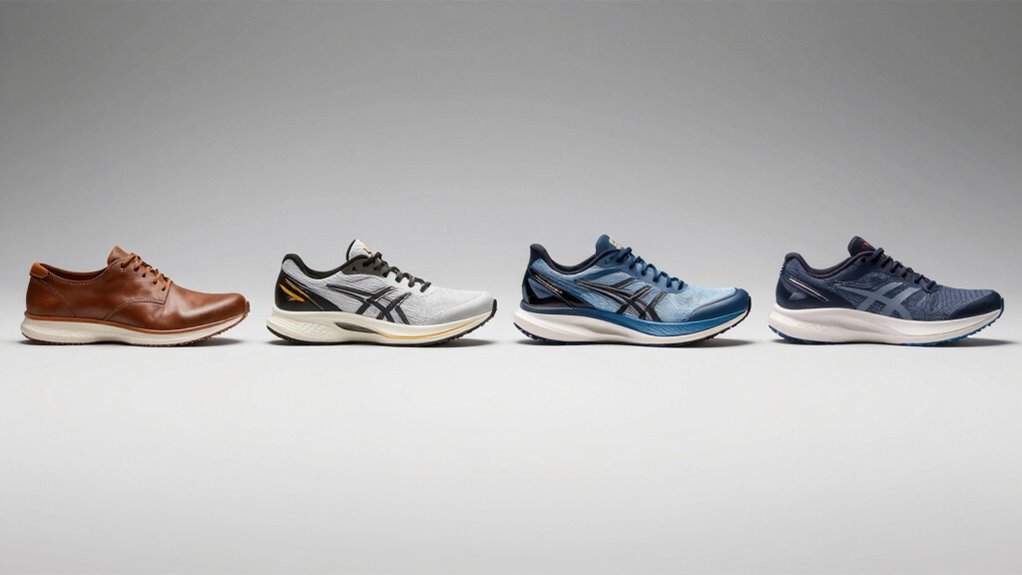
You can trace running shoes from animal-hide sandals and leather soles through mid-1800s plimsolls with vulcanized rubber to J.W. Foster’s spiked specialists and the Dassler split that birthed Adidas and Puma. Postwar sneakers grew into mass-market casuals, then technical runners with Bowerman’s waffle sole, EVA foams, and Nike Air. Recent trends moved from minimal knits to carbon-plated “super shoes,” plus sustainability and customization—keep going and you’ll uncover the detailed innovations and timelines.
Origins of Running Shoes (Pre-1800s–1865)
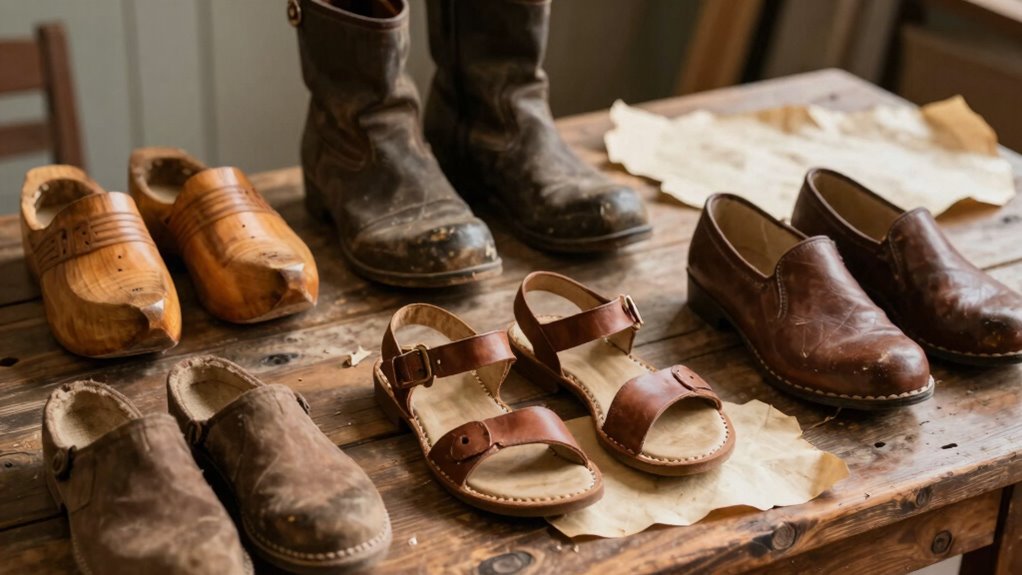
Although shoes had existed for millennia, the forms and materials used before the 19th century laid the foundation for what you’d recognize as running footwear today.
You trace early footwear to animal-hide constructions from ancient Egypt around 3500 BCE, which offered basic protection and shaped the idea of a sole. By 1600 BCE, Greeks refined designs with leather, improving fit and flexibility so you’d move more naturally.
From Egyptian hide soles to Greek leather fits, early footwear evolved to protect feet and enable more natural movement.
Romans later added iron nails to secure soles, enhancing durability for prolonged activity that included athletic pursuits. By mid-1800s developments in rubber processing enabled lightweight options.
You’ll also note an early specialized example from Northampton: a dress-like shoe fitted with spikes for cross-country running. These innovations set material and design precedents for later plimsolls and rubber soles.
From Plimsolls to Rubber Soles (Mid-1800s–1895)
You’ll see how mid-1800s plimsolls paired simple canvas uppers with newly vulcanized rubber soles to create lightweight, practical shoes for sport.
These designs used the vulcanization breakthrough to bond rubber and cloth, producing soles that were more durable and quieter than previous footwear.
As manufacturers refined canvas-and-rubber uppers, athletes began to get shoes that combined flexibility, grip, and support suited to running.
Early plimsolls often lacked modern arch support, which later designs addressed to accommodate different arch characteristics.
Early Plimsoll Designs
When lightweight plimsolls began appearing in the mid-1800s, they marked a clear shift from heavy, stiff footwear toward shoes designed for sport and leisure, using canvas uppers bonded to rubber soles through the newly practical vulcanization process.
You’d recognize these plimsolls as the first truly lightweight athletic shoes: canvas bodies, flexible rubber soles, and a focus on comfort and mobility that supported recreational running and gym activities.
Early innovators experimented with improving performance, adding features like nailed-on spikes for cross-country grip and modest structural supports.
By the 1860s and into the 1890s, makers in England refined spike placement and introduced lateral bands for stability.
These developments set practical expectations for running footwear and guided later technical refinements.
Over time, materials and geometry evolved to prioritize foam composition and rocker profiles that change cushioning and running feel.
Vulcanized Rubber Emerges
Once vulcanization made rubber stable and moldable in the mid-1800s, shoemakers could fuse rubber to cloth in ways that produced genuinely lightweight, flexible footwear suited to sport and leisure.
You’d see plimsolls emerge with rubber soles that reduced weight and increased traction, signaling a shift toward purpose-built athletic shoes.
In 1865 Northampton craftsmen produced a running shoe resembling a dress shoe but fitted with spikes for cross-country use, showing how design adapted to specific performance needs.
By 1895 J.W. Foster and Sons introduced lighter spikes and a lateral support band, further improving stability and speed.
These innovations laid groundwork for broader adoption of rubber-soled footwear, as athletes valued reduced weight, silent movement, and measurable gains in performance.
This shift toward specialized footwear also began emphasizing traction and cushioning as distinct design priorities for different running needs.
Canvas And Rubber Uppers
Building on the newfound ability to fuse rubber with cloth, shoemakers in the mid-1800s began producing lightweight canvas uppers bonded to rubber soles, creating footwear that met the practical needs of sports and leisure.
You’d recognize these early plimsolls as simple, affordable canvas shoes with rubber bottoms that offered flexibility and quieter movement than leather boots.
Vulcanization made that fusion durable, and by 1865 manufacturers in Northampton added spikes to dress-like running shoes to improve traction for athletes.
As you follow the timeline, Joseph William Foster appears in 1890, founding J.W. Foster and Sons and innovating leather-spiked athletic footwear worn by prominent British competitors.
These developments set the foundation for the sneaker boom that would follow after World War I.
Later innovations emphasized enhanced cushioning and outsole durability to support heavier runners and extend shoe lifespan.
Spikes and Early Specialists (1895–1920s)
Although athletic footwear was still in its infancy at the turn of the 20th century, manufacturers were already adapting designs to meet the demands of competitive running. Those changes set the stage for modern track shoes.
You see the emergence of spikes and purpose-built running shoes: leather uppers with metal spikes improved traction, while lighter constructions reduced weight. J.W. Foster and Sons led early specialization in 1895, adding a lateral support band and lighter spikes that enhanced stability and performance.
Their shoes reached Olympians in the 1920s, demonstrating how targeted design altered outcomes on the track. Early vulcanized plimsolls provided an alternative for some events, signaling broader experimentation in athletic footwear.
By the 1920s, purpose-built shoes reached Olympians, while vulcanized plimsolls expanded experimental options on the track.
- Leather uppers with metal spikes
- Lateral support innovations
- Vulcanized rubber plimsolls
- Early specialist makers influencing sport evolution
Manufacturers began to recognize how different arch types, such as high arches, could affect a runner’s gait and injury risk, influencing later design priorities.
Dassler Split: Adidas and Puma Emerge (1920s–1949)
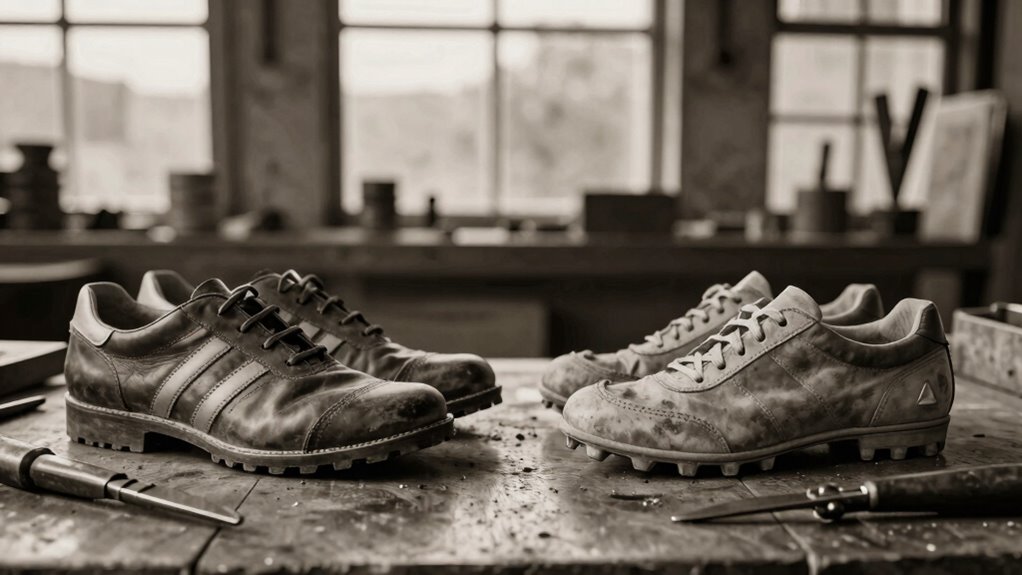
You’ll see how a family business in Herzogenaurach, started by brothers Adi and Rudolf Dassler in the 1920s, evolved into two distinct companies after a bitter breakup in the late 1940s.
That split produced Puma in 1948 and Adidas in 1949, each quickly pursuing their own designs and innovations that reshaped athletic footwear.
Understanding this origin story helps explain the long-running rivalry and how competition between the brands accelerated advances in sports shoe technology and marketing.
Family Business Breakup
When the Dassler brothers turned their small workshop into the Dassler Brothers Sports Shoe Factory in Herzogenaurach during the 1920s, they set the stage for one of the most consequential splits in sporting goods history.
You’ll see how a personal rift transformed the shoe industry: disagreements culminated in a 1948 breakup that sent Rudolf off to form Puma and Adi to found Adidas, reshaping athletic footwear competition.
That rivalry accelerated innovation as each brand pursued performance, style, and athlete endorsements. You can trace how sponsorships, logos, and design advances emerged from this split.
Consider these key outcomes:
- Intensified competition that spurred rapid technological development
- Emergence of distinct brand identities and marketing strategies
- Increased athlete sponsorships and global visibility
- Lasting influence on modern athletic footwear design and industry standards
Adidas And Puma Origins
After years of collaboration in a small Herzogenaurach workshop, the personal and professional rift between brothers Adi and Rudolf Dassler split their thriving enterprise and set the stage for two distinct athletic empires.
You’ll see how the Dassler Brothers’ early work in the 1920s pioneered athletic footwear, producing specialized shoes for track and field that gained international attention after Jesse Owens’ 1936 success.
In 1948 the split produced Puma and adidas, with Rudolf founding Puma and Adi registering adidas in 1949.
You’ll note adidas introduced innovations like the first sport shoe with a synthetic upper, while both brands’ rivalry accelerated advances in performance and design.
Understanding this split helps you trace modern running shoe development and industry dynamics.
Postwar Sneaker Boom and Mass Market (1950s–1960s)
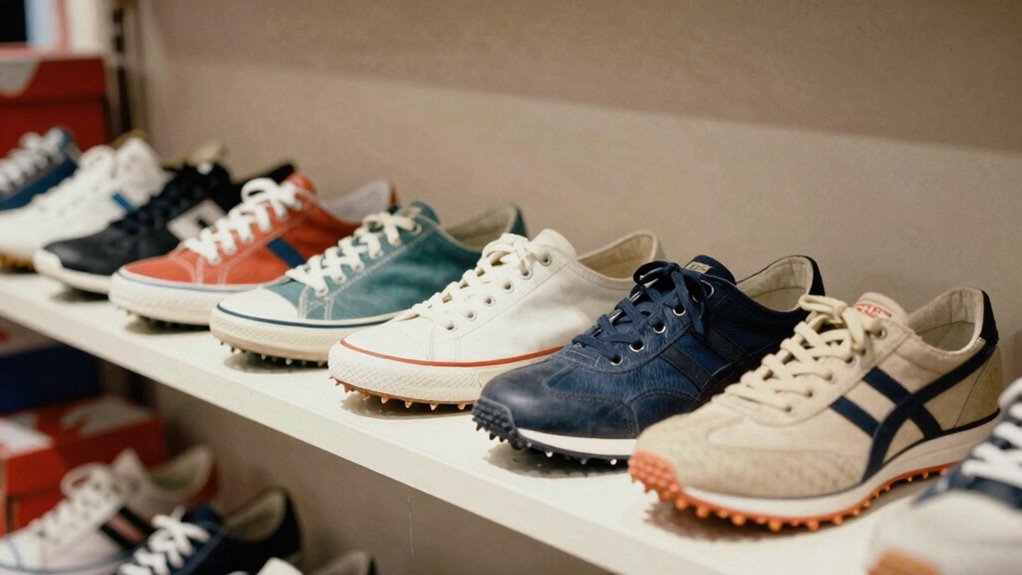
Although the postwar years were defined by broader social change, the 1950s brought a clear shift in how Americans dressed and moved, as casual sneakers moved from niche athletic gear into everyday wear.
You’ll notice Keds and Converse leading this trend, marketing athletic footwear for leisure while sport gained cultural cachet.
By the 1960s the running boom encouraged more people to run, and firms like Blue Ribbon Sports—later Nike—pursued lightweight designs that bridged performance and daily wear.
Brands used celebrity endorsements and targeted campaigns to broaden appeal, making shoes both tools for exercise and fashion statements.
You benefit now from that shift whenever you choose sneakers designed for comfort, style, and activity.
- Brands expanded retail distribution.
- Designs prioritized comfort and weight.
- Running culture entered mainstream life.
- Marketing blurred sport and fashion.
Waffle Sole, EVA and Cushioning Breakthroughs (1970s–1980s)
As running shifted from casual pastime to serious pursuit, the 1970s and 1980s saw a series of technical breakthroughs that redefined shoe performance and comfort.
You witnessed Bill Bowerman’s waffle sole reshape running shoe design by improving traction across surfaces, letting you push harder with more confidence.
In 1974 Brooks introduced EVA foam in the Villanova, giving you lighter, more responsive cushioning that reduced fatigue.
Nike’s Air technology followed in 1978, adding air cushioning that enhanced shock absorption for long-distance efforts.
By the 1980s manufacturers were layering foams of different densities to balance cushioning with support, refining ride and durability.
By the 1980s, layered foams of varying density tuned cushioning and support, sharpening ride quality and durability.
These advances collectively shifted expectations for comfort, protection and performance in modern running footwear.
Stability, Gels and Visible Tech (1980s–2000s)
When stability became as important as cushioning in the 1980s and 1990s, manufacturers began pairing targeted support systems with advanced shock-absorbing materials to protect runners and improve efficiency.
You saw Brooks introduce dual-density foam in the Chariot for enhanced stability, and Mizuno later combine cushioning with Wave technology to aid running economy and injury prevention.
Asics’ Gel cushioning, first used on the GT-II and Freaks, shifted midsole design toward localized shock control.
Nike made cushioning visible with the Air Max 1 and added the Torsion system to stabilize the midfoot dynamically.
These advances show how technology sought both comfort and performance without sacrificing support.
- Dual-density midsoles for targeted support
- Visible cushioning innovations
- Midfoot stability systems for injury prevention
- Gel-based shock absorption
Minimalism, Knits and Data-Driven Shoes (2000s–2013)
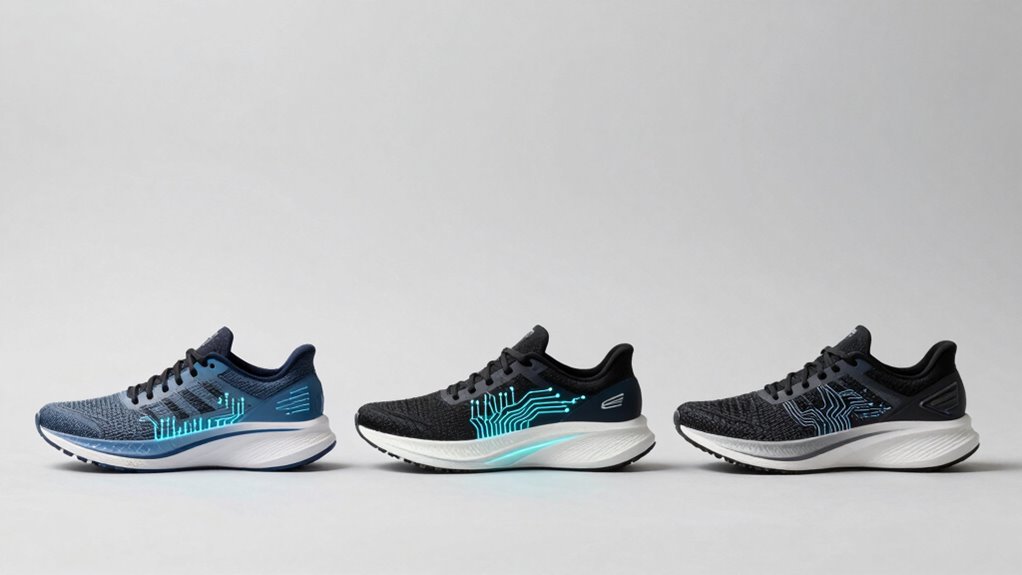
By the early 2000s the running shoe industry shifted focus from layered cushioning and stability systems toward a trio of new priorities: stripping back to more natural foot mechanics, refining upper construction, and using digital data to inform design and training.
You’ll see barefoot running trends push minimal shoes into mainstream conversation, led by Vibram FiveFingers and Nike Free (introduced in 2001) which aimed to mimic ground feel while retaining some protection.
In 2012 Flyknit technology transformed uppers, offering lightweight, precise fit and reduced material waste.
Around 2013 Adidas introduced Boost technology, enhancing energy return and cushioning chemistry.
Simultaneously, data-driven shoes such as Altra Torin IQ began embedding sensors to give real-time feedback, helping you analyze form and adjust training objectively.
Super Shoes, Sustainability and Customization (2013–Present)
Although performance-driven innovation continued across the industry, the period after 2013 really crystallized three parallel trends: “super shoes” that use carbon plates and novel foams to measurably boost race performance, a growing emphasis on sustainability in materials and manufacturing, and broader options for customization to match individual runners.
After 2013 running shoes split into three paths: carbon-powered speed, sustainable materials, and personalized fit.
You’ll see super shoes like Nike’s Vaporfly using carbon fiber plates and advanced foams to improve efficiency, while Adidas’s Boost increased cushioning and energy return.
At the same time, brands embraced sustainability—Adidas Parley and On’s Cyclon pushed eco-friendly designs and recyclable components.
Customization also expanded, with bespoke systems tuning fit and function for terrain and gait, so you can choose shoes that match performance goals and environmental values.
- Nike Vaporfly: carbon plate race revolution
- Adidas Boost: enhanced energy return
- Parley/Cyclon: eco-friendly designs
- Salomon: fit-focused customization
Wrapping It Up
You’ve traced a path from leather-soled beginnings to carbon-plated “super shoes,” watching materials, science, and culture reshape every stitch and sole. Picture hands shaping rubber, engineers tuning foam, and runners testing limits—each era layering innovation atop the last. That history shows you how performance, comfort, and sustainability converge in modern design, and it guides choices for training, competition, and daily wear as you pick shoes that match your stride, goals, and values.
I’m buying an older pair mostly to put on a shelf in my office, and I can’t decide between an early leather-and-rubber style or a vintage track spike. Which one usually reads more clearly as a real piece of running history without looking too beat up?
An early leather-and-rubber style usually works better for display if you want the history to be easy to read at a glance. It shows the transition from basic protective footwear into purpose-built running shoes, and it tends to look less specialized than a spike. A vintage track spike can be a stronger choice if you want a more obvious athletic story, but it often looks narrow, delicate, and more condition-sensitive. For a home office, I would check the upper, sole separation, and whether the original shape is still intact before choosing.